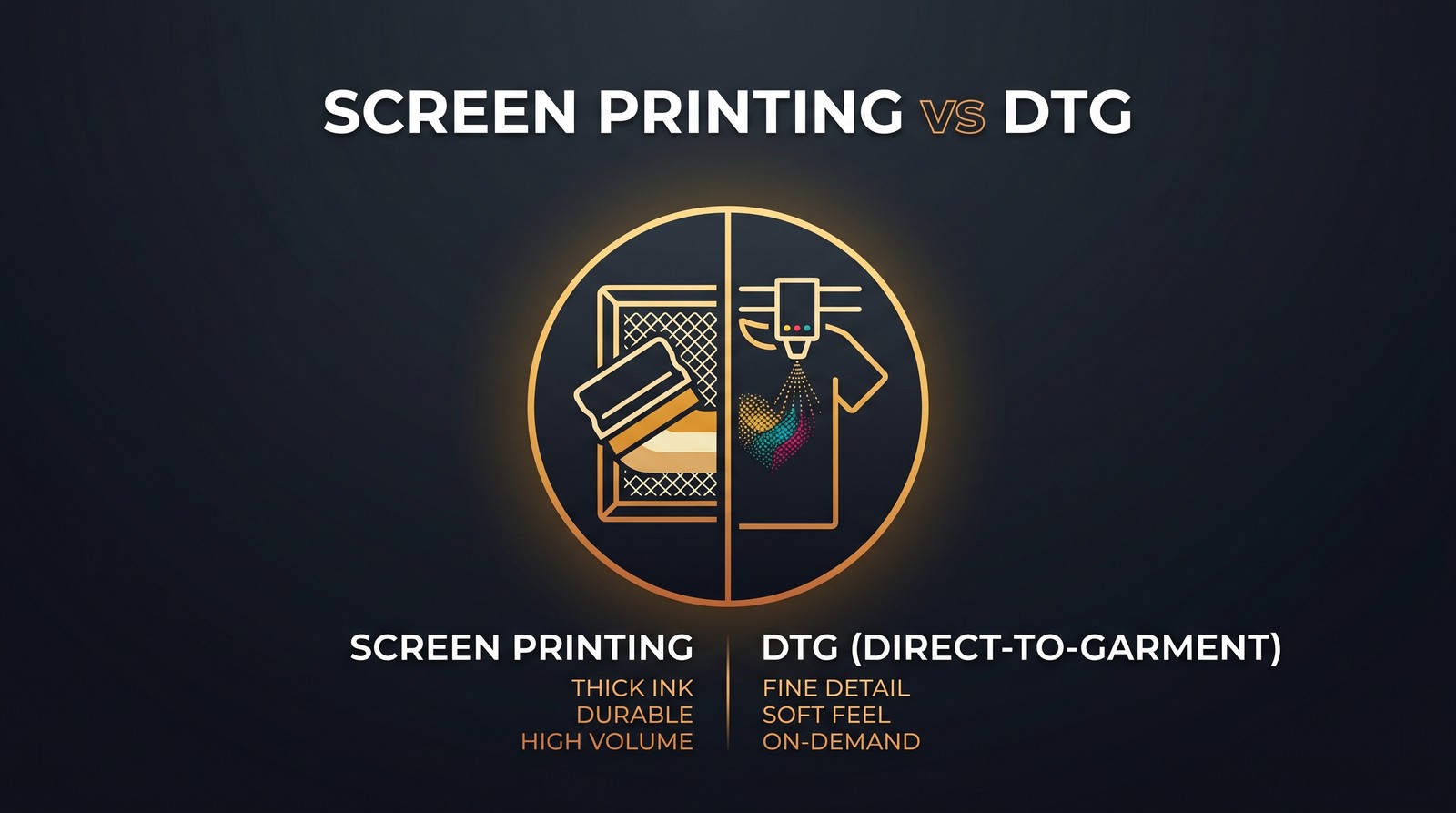
Most people asking about screen printing vs DTG are overthinking it. If you run a print on demand business, the answer is already decided for you. DTG is the method that POD platforms use. Screen printing is the method that custom print shops use. They solve different problems.
But that surface-level answer misses the real opportunity. Understanding both methods makes you a better seller because it changes how you think about scaling, margins, and which designs are worth investing in. We've seen sellers leave serious money on the table by never considering screen printing for their top performers.
What Is Screen Printing vs DTG?
These two methods represent fundamentally different approaches to putting ink on a shirt. Screen printing is the older, industrial method that has been around since the 1900s. DTG is the digital newcomer that only became commercially viable in the mid-2000s.
The core difference is economics. Screen printing has high fixed costs (making screens) but low variable costs (each additional print is cheap). DTG has zero fixed costs but higher per-unit costs. That crossover point, usually around 25-50 units, determines which method wins for any given order.
How Screen Printing Works
Screen printing, also called silk screening, is a stencil-based process. Here's the simplified workflow:
- A design is separated into individual color layers
- Each color gets its own mesh screen with a photo-emulsion stencil
- The printer loads a screen, floods ink across it, and uses a squeegee to push ink through the open mesh areas onto the garment
- The process repeats for each color in the design
- The garment goes through a conveyor dryer to cure the ink
Each color in the design requires a separate screen. A 4-color design needs 4 screens, 4 ink setups, and 4 passes through the press. This is why screen printing gets expensive fast for complex, multi-color designs.
The upside? Once those screens are made and the press is dialed in, you can crank out hundreds of identical prints per hour at pennies per unit. Screen printing excels at volume, and the ink sits on top of the fabric in thick, vibrant layers that hold up for years.
How DTG Printing Works
Direct to garment printing is the process most print on demand t-shirt sellers interact with, even if they never see the machine. Here's what happens after a customer places an order:
- The garment is pre-treated with a solution that helps ink bond to fabric (especially important for dark garments)
- The shirt is loaded onto a platen and fed into the DTG printer
- The printer sprays water-based textile ink directly onto the fabric, similar to how a desktop inkjet prints on paper
- A heat press or conveyor dryer cures the ink at around 330°F
DTG prints the entire design in a single pass, regardless of how many colors are in it. A photorealistic design with a million colors costs the same to print as a simple one-color text design. This is the fundamental advantage for POD.
The trade-off is speed and scale. A DTG printer handles roughly 10-30 shirts per hour depending on the machine, while a screen printing press can run 200-500 per hour once it's set up.
Want to do this yourself? Merch Titans automates the entire process.
Screen Printing vs DTG: The Full Comparison
Let's break this down across every dimension that matters to your business.
Cost Breakdown: Where the Numbers Cross
This is where most comparisons get it wrong. They show per-unit costs without factoring in setup fees and minimums.
DTG cost structure:
- Setup fee: $0
- Per-unit cost: $8-15 (varies by printer and garment)
- 1 shirt = $8-15 total
- 50 shirts = $400-750 total
Screen printing cost structure:
- Setup fee: $25-50 per screen (per color)
- Per-unit cost: $2-5 at volume
- 1 shirt (4-color design) = $125-200+ total (setup kills you)
- 50 shirts (4-color design) = $200-450 total
The break-even point sits around 25-50 units per design for simple designs. For complex designs with 6+ colors, DTG stays cheaper well past 100 units because each additional screen printing color adds another $25-50 in setup.
Print Quality: It Depends on the Design
This is not a "one is better" situation. The quality comparison depends entirely on what you're printing.
Screen printing wins for:
- Bold, simple graphics with 1-4 colors
- Spot color accuracy (Pantone matching)
- Thick, raised ink feel (especially with puff or metallic inks)
- White prints on dark garments
DTG wins for:
- Photographic images and portraits
- Designs with gradients, shadows, or transparency
- Anything with more than 6 colors
- Detailed artwork with fine lines
For the typical POD seller creating designs in Photoshop or Illustrator, DTG reproduces artwork more faithfully. You design it, upload it, and what the customer receives looks like what you designed. Screen printing requires color separations and design modifications that can change the final look.
Durability: Screen Printing Has the Edge
We won't sugarcoat this. Screen printing is more durable than DTG, period.
Screen printed ink sits on top of the fabric in thick layers. It can withstand 100+ washes without significant fading when properly cured. The ink becomes part of the fabric's structure.
DTG ink absorbs into the fabric fibers. It produces softer prints with no hand feel (which some customers prefer), but it fades faster. Modern DTG inks have closed the gap significantly. A properly pre-treated and cured DTG print will last 50+ washes. But screen printing still wins the longevity contest.
For POD sellers, this durability gap is rarely a deal-breaker. Your customers are buying unique designs, not workwear. Most POD shirts won't see 50+ washes before the owner moves on.
Scale Your Best Designs Faster
Merch Titans helps you identify winning designs worth scaling to bulk production.
Get Started Today →14-day money-back guarantee · Used by 150,000+ sellers since 2018
Why DTG Is the Only Real Option for POD
Here's the thing. The screen printing vs DTG debate is interesting in theory, but for print on demand businesses, DTG already won. Here's why:
No POD platform uses screen printing for fulfillment. Amazon Merch on Demand, Printful, Printify, Redbubble, TeeSpring, and every other major POD provider uses DTG (or DTF, a newer variant) for apparel orders. They can't screen print because the model requires printing single units of thousands of different designs daily.
Screen printing needs you to commit inventory upfront. You need to guess which designs will sell, order 50+ of each, store them, and ship them yourself. That is the exact opposite of the POD model.
DTG enables the POD business model. Without DTG technology, print on demand as we know it wouldn't exist. The ability to print a single custom shirt profitably is what makes the entire industry work.
When Screen Printing Still Makes Sense for POD Sellers
Now here's the contrarian take that most POD guides skip. Just because your business runs on DTG doesn't mean screen printing is irrelevant to you.
Your top 1% of designs deserve screen printing. If you have a design that consistently sells 50+ units per month, you should seriously consider getting it screen printed and fulfilling those orders yourself (or through a hybrid service).
Why? The math is compelling:
- DTG cost per unit: ~$10-12
- Screen printed cost per unit at 200 qty: ~$3-5
- Margin increase: $5-9 per shirt on your best sellers
We've watched sellers who identify their top 5 performing designs, get them screen printed in popular sizes, and handle fulfillment themselves. The margin jump is massive. You go from making $5-8 profit per shirt on DTG to $12-18 per shirt on screen printed inventory.
This hybrid approach, DTG for the long tail and screen printing for proven winners, is how the smartest POD sellers scale past six figures.
Screen Printing vs DTG vs Sublimation: Know the Difference
If you've read our sublimation vs screen printing comparison, you know sublimation is a third option in this space. Quick breakdown of how all three compare:
- DTG prints on cotton and cotton blends. Best for standard POD apparel.
- Sublimation works only on polyester and poly-coated items. Best for all-over prints and non-apparel products (mugs, phone cases).
- Screen printing works on almost anything. Best for bulk orders with simple designs.
These methods don't compete as much as they complement each other. A well-rounded POD seller might use DTG for cotton tees, sublimation for polyester products and all-over prints, and screen printing for bulk runs of bestsellers.
Don't pick one and ignore the others. Understanding when to use each method is a competitive advantage.
The Fabric Factor: Not All Materials Work the Same
One detail that trips up newer sellers: both DTG and screen printing produce their best results on different fabrics.
DTG performs best on:
- 100% ring-spun cotton (the gold standard)
- 80/20 cotton-poly blends (acceptable results)
- Light-colored garments (no pre-treatment needed)
Screen printing performs best on:
- 100% cotton (classic choice)
- Cotton-poly blends (works well)
- Polyester (with specialty low-bleed inks)
- Non-fabric surfaces like wood, metal, and paper
If you're designing t-shirts for print on demand, stick with 100% cotton garment options. Both DTG and screen printing deliver their best quality on cotton, and customers prefer the feel. The Bella+Canvas 3001 and Next Level 3600 are industry standards for a reason.
Best Printing Method for T-Shirts in 2026
The best printing method for t-shirts depends entirely on your business model.
Choose DTG if:
- You sell through POD platforms (Amazon Merch, Printful, Printify)
- You don't want to hold inventory
- Your designs have more than 4 colors
- You're testing new designs frequently
- You want zero upfront investment per design
Choose screen printing if:
- You have proven designs selling 50+ units monthly
- Your designs use 1-4 solid colors
- You want maximum durability
- You're willing to hold and ship inventory
- You're doing event merch, team uniforms, or promotional products
For most POD sellers reading this, DTG is your answer. Use your free keyword research tools to find profitable niches, create designs, upload them through your POD platform, and let DTG fulfillment handle the rest. That's the model that scales without risk.
The sellers who graduate to screen printing don't abandon DTG. They add screen printing as a second fulfillment channel for their proven winners. That's the smart play.
Merch Titans Automation
Find Winning Designs Worth Scaling
Merch Titans gives you the research and automation tools to identify bestsellers and scale your POD business faster.
14-day money-back guarantee · No contracts · Cancel anytime
Your printing method doesn't determine your success. Your designs, your niche research, and your volume do. Pick the method that matches your business model today, and revisit the decision when your numbers change. The best POD sellers aren't loyal to a printing method. They're loyal to their margins.
Frequently Asked Questions
What is DTG printing?
DTG (direct to garment) printing uses specialized inkjet printers to spray water-based ink directly onto fabric, producing full-color prints without screens or setup fees. It works similarly to a paper inkjet printer but is engineered for textiles, making it the standard fulfillment method for print on demand platforms.
Is screen printing better quality than DTG?
Screen printing produces thicker ink deposits that feel more vibrant on dark garments and last longer through repeated washes. However, DTG matches or exceeds screen printing for photographic detail, color gradients, and designs with more than 6 colors. Quality depends on the specific design, not the method alone.
Which is cheaper for small orders?
DTG is significantly cheaper for small orders because it requires zero setup cost per design. Screen printing demands screens, inks, and labor for each new design, making it cost-prohibitive below 25-50 units. A single DTG print typically runs $8-15, while screen printing a single shirt can cost $25-50 after setup.
How long do DTG prints last?
DTG prints last 50+ washes when properly cured and pre-treated, though they may fade slightly faster than screen prints over time. Following care instructions like washing inside-out on cold and tumble drying on low extends DTG print life significantly. Modern DTG inks have improved durability dramatically compared to early versions.
Can you screen print on any fabric?
Screen printing works on cotton, polyester, blends, and even non-fabric surfaces like wood and metal, but results vary by material. Cotton delivers the best results for screen printing. Polyester requires special low-bleed inks to prevent dye migration, and some synthetic fabrics don't absorb screen printing ink well at all.
What printing method is best for POD?
DTG is the best printing method for print on demand because it supports unlimited colors, requires no minimum order quantities, and integrates directly with POD fulfillment workflows. Every major POD platform including Printful, Printify, and Amazon Merch on Demand uses DTG as their primary printing method for apparel.