Most POD sellers never think about what happens after they hit upload. Your design file disappears into the fulfillment pipeline, and a finished product shows up at your customer's door. But the printing method behind that product determines your profit margin, print quality, customer satisfaction, and return rate.
DTG printing powers the vast majority of print-on-demand products sold online today. If you are selling custom t-shirts through Amazon Merch on Demand, Printful, Printify, or any major POD platform, your designs are almost certainly being printed with DTG technology.
What Is DTG Printing?
Think of DTG as an oversized inkjet printer built specifically for textiles. The process is straightforward: a garment gets loaded onto a flat platen, the printer head moves across the fabric spraying CMYK (plus white) ink in precise patterns, and the result is a high-resolution print bonded directly to the fibers.
The technology matured rapidly between 2015 and 2025. Early DTG printers were slow, expensive, and unreliable. Today's machines from Kornit, Brother, and Epson handle hundreds of shirts per day with consistent quality that rivals screen printing on most designs.
How DTG Printing Actually Works (Step by Step)
-
Pre-treatment - The garment is sprayed with a liquid pre-treatment solution that helps ink adhere to the fabric. This step is especially critical for dark garments where white ink needs an anchor layer.
-
Loading - The shirt is placed flat on the printer's platen (a flat surface that holds the garment in position). Wrinkles get smoothed out because any fold creates print defects.
-
White ink base (dark garments only) - For dark-colored shirts, the printer lays down a white ink layer first. This acts as a canvas so the CMYK colors show accurately against the dark fabric.
-
CMYK color pass - The print head sprays cyan, magenta, yellow, and black inks in a single pass, building the full-color image directly on the garment.
-
Curing - The printed garment passes through a heat press or conveyor dryer at around 330°F for 60-90 seconds. This bonds the ink permanently to the fibers.
The entire process takes 2-5 minutes per garment for a standard chest print. That speed is what makes DTG viable for single-unit print-on-demand fulfillment.
DTG vs DTF Printing: Which Method Wins?
DTF (direct-to-film) printing has exploded in popularity since 2023, and for good reason. But the two methods serve different use cases.
DTF printing works by printing onto a special PET film, applying adhesive powder, curing it, then heat-pressing the transfer onto the garment. The result is a flexible, vibrant print that sits slightly on top of the fabric rather than soaking into it.
| Factor | DTG | DTF |
|---|---|---|
| Print feel | Soft, breathes with fabric | Slightly raised, film-like |
| Best fabric | 100% cotton | Any fabric including synthetics |
| Color on darks | Good with pre-treatment | Excellent without pre-treatment |
| Setup cost per design | Zero | Zero |
| Cost per unit | $5-$15 | $3-$10 |
| Wash durability | 50+ washes | 50+ washes |
| POD integration | Native on most platforms | Limited, growing |
For print-on-demand sellers, DTG is still the practical winner. Here is why: every major POD fulfillment partner (Printful, Printify, Gooten, Amazon Merch) uses DTG as their primary printing method. Your designs integrate seamlessly. No extra steps, no special file formats, no transfer hassle.
DTF shines when you are doing your own fulfillment or selling at events. The lower per-unit cost and ability to print on polyester, nylon, and blends gives DTF an edge for custom merchandise production.
Want to do this yourself? Merch Titans automates the entire process.
DTG vs Screen Printing: The Cost Crossover Point
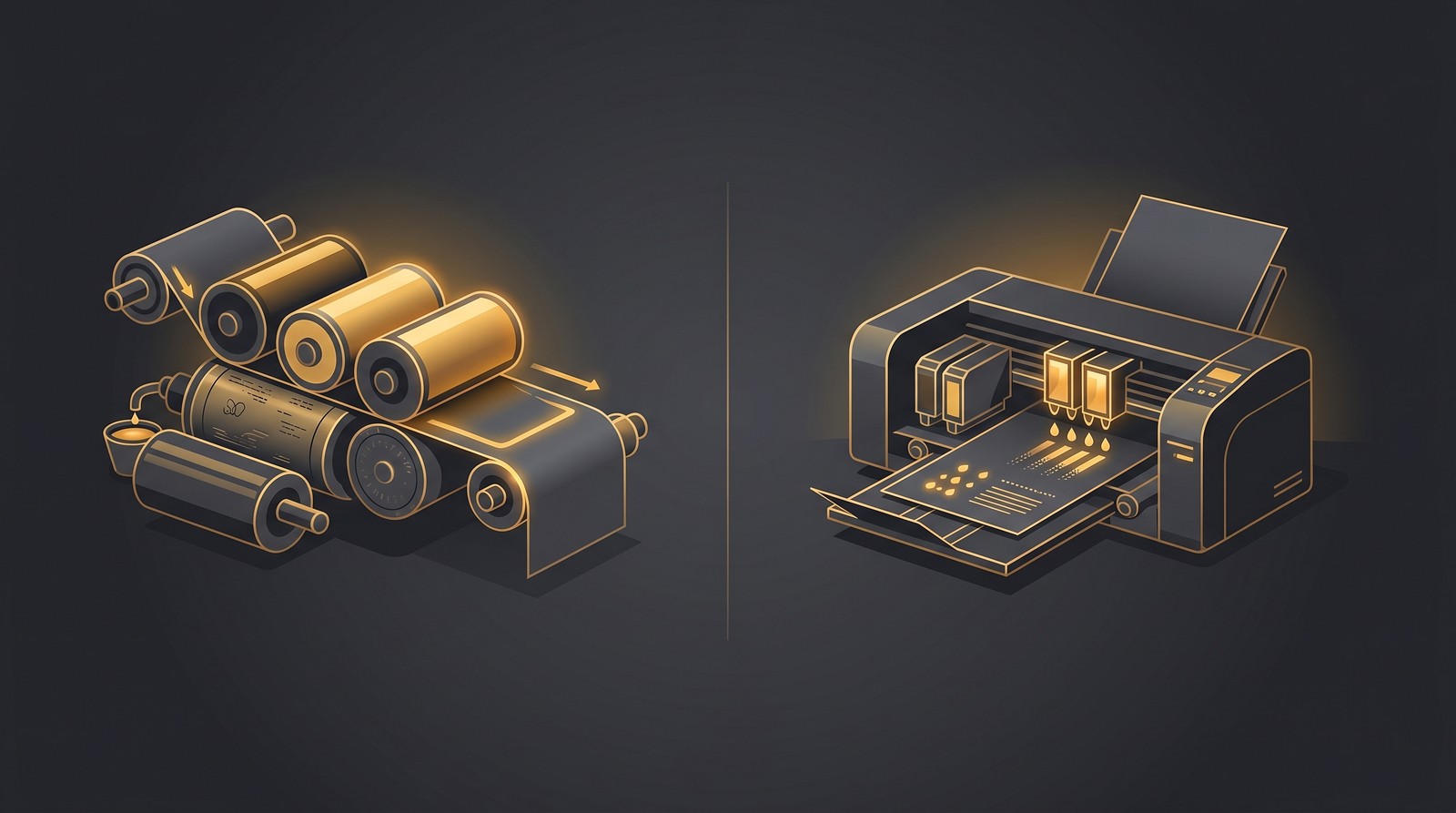
Screen printing has been the industry standard for decades. It produces incredibly vibrant, durable prints - but it requires creating physical screens for each color in your design.
Screen printing becomes cheaper than DTG at roughly 50 units of the same design. Below that threshold, DTG wins on cost because there is zero setup.
Here is the breakdown for a standard 4-color chest print:
- 1 unit: DTG = ~$12/shirt. Screen print = ~$65/shirt (setup amortized across one unit)
- 25 units: DTG = ~$10/shirt. Screen print = ~$9/shirt
- 100 units: DTG = ~$8/shirt. Screen print = ~$4/shirt
- 500 units: DTG = ~$7/shirt. Screen print = ~$2.50/shirt
For POD sellers, this comparison barely matters. You are selling individual units to individual customers. Your fulfillment partner handles the printing at their scale. The per-unit economics of DTG at single-unit volumes is exactly what makes print-on-demand viable.
Where screen printing still dominates: bulk orders for teams, events, corporate merch, and any situation where you are printing 50+ copies of the same design.
Color Limitations
Screen printing charges per color - a 6-color design costs significantly more than a 2-color design. DTG prints unlimited colors at the same price. This is a massive advantage for photographic designs, gradients, and complex artwork.
If your design strategy involves detailed illustrations or photo-based graphics, DTG gives you creative freedom that screen printing simply cannot match at reasonable cost.
DTG Print Quality: What Sellers Need to Know
The quality gap between DTG and screen printing has narrowed dramatically. Modern DTG printers produce prints at 1200 DPI or higher, capturing fine details that would be impossible with screen mesh.
Where DTG excels:
- Photographic images and gradients
- Designs with many colors (8+ colors)
- Fine text and small details
- Complex illustrations with subtle shading
Where DTG struggles:
- Neon and fluorescent colors (limited ink gamut)
- Large solid color blocks (screen printing lays heavier ink)
- Extremely dark, saturated backgrounds on light shirts
- Synthetic fabrics (cotton is DTG's sweet spot)
Fabric Matters More Than You Think
DTG works best on 100% cotton or high-cotton blends (80/20 minimum). The water-based inks are designed to penetrate cotton fibers. Polyester and synthetic fabrics cause the ink to sit on the surface, leading to poor wash durability and color bleeding.
This is why most POD platforms default to cotton or cotton-blend blanks for DTG products. When you see a POD provider offering polyester options, they are likely using DTF or sublimation instead.
DTG Printing Costs for POD Sellers
Your actual cost as a POD seller is not the raw DTG printing cost. It is the base price your fulfillment partner charges, which includes printing, blank garment, and their margin.
Typical POD platform base prices for a standard DTG t-shirt:
- Amazon Merch on Demand: You set the price, Amazon takes production cost + commission. Effective base ~$7-$10.
- Printful: $9.25+ for a standard Gildan t-shirt with front print
- Printify: $5.33+ depending on print provider (some use DTG, some DTF)
- Gooten: $6.50+ for basic tee options
Your profit margin lives in the gap between base cost and retail price. A shirt with a $9 base cost sold at $24.99 gives you roughly $10-$12 after platform fees. Scale that across hundreds of designs and thousands of orders, and DTG-powered POD becomes a legitimate income stream.
Automate Your POD Uploads Across Platforms
Merch Titans lets you publish designs to multiple marketplaces in minutes, not hours.
Get Started Today →14-day money-back guarantee · Used by 150,000+ sellers since 2018
When to Choose Each Printing Method
The right printing method depends on your business model, not just the technology specs.
Choose DTG When:
- You are selling through print-on-demand platforms (this is most of you)
- Your designs use many colors, gradients, or photographic elements
- You need zero-inventory, zero-upfront-cost fulfillment
- You want to test hundreds of designs without financial risk
- You are selling on cotton or cotton-blend products
Choose DTF When:
- You are doing your own fulfillment or local production
- You need to print on polyester, nylon, or synthetic fabrics
- You are producing custom merch for events or small batches
- You want vibrant prints on dark garments without pre-treatment headaches
Choose Screen Printing When:
- You are ordering 50+ units of the same design
- You need maximum color vibrancy and ink opacity
- Your designs use 1-4 solid colors (simple graphics, logos, text)
- You are producing branded merchandise, uniforms, or event shirts
The Future of DTG in Print on Demand
DTG technology keeps getting faster and cheaper. Kornit's latest systems print a full-color shirt in under 15 seconds. As print speeds increase and ink costs decrease, the per-unit economics improve for everyone in the POD ecosystem.
The real trend to watch is hybrid fulfillment. Smart POD platforms are starting to route orders to the optimal printing method automatically - DTG for cotton, DTF for synthetics, sublimation for all-over prints. As a seller, you will not need to choose. The platform optimizes behind the scenes.
For now, understanding DTG gives you an edge. You can design specifically for DTG strengths (detailed artwork, unlimited colors, cotton-first products), choose the right blanks, and set pricing that accounts for actual production costs.
How Automation Changes the Game
The real bottleneck for POD sellers is not the printing - it is the uploading, listing optimization, and multi-platform management. A single design that could sell on Amazon Merch, Etsy, and Redbubble takes 30-45 minutes to list manually on each platform.
This is exactly why tools like Merch Titans exist. Bulk uploading, keyword research, and multi-marketplace management eliminate the operational drag so you can focus on what actually moves the needle - creating designs that sell.
Common DTG Printing Mistakes (and How to Avoid Them)
We have seen thousands of POD sellers make these errors:
Low-resolution uploads. If your design file is under 300 DPI at print size, the DTG output will look fuzzy. Always export at 4500×5400 pixels for a standard front print area.
Ignoring the blank color. A design that pops on a white mockup might look completely different on a heather grey or navy shirt. DTG white ink under-base affects how colors render on dark garments.
Over-designing. Complex designs with tiny details often lose clarity in DTG printing. Elements smaller than 1mm can blur or disappear entirely. Design with print limitations in mind.
Forgetting about the feel. Heavy ink coverage on DTG creates a stiffer print feel. Designs with large solid areas will feel noticeably different than designs with open space. Customers notice.
DTG Printing and Sustainability
A growing number of consumers care about how their products are made. DTG has some genuine environmental advantages worth knowing.
Water-based inks are non-toxic and produce zero volatile organic compounds (VOCs). Compare that to plastisol inks used in traditional screen printing, which require chemical solvents for cleanup.
DTG also produces zero waste from unused transfers (unlike DTF) and has no screen disposal costs. The print-on-demand model itself eliminates inventory waste since garments are only produced when ordered.
This is a selling point you can use in your listings. Eco-conscious buyers specifically search for sustainably produced apparel, and DTG's environmental profile is genuinely better than most alternatives.
Merch Titans Automation
Scale Your POD Business with Smart Automation
From keyword research to bulk uploads, Merch Titans gives you the tools to grow faster.
14-day money-back guarantee · No contracts · Cancel anytime
The sellers who win in POD are not the ones obsessing over printing technology. They are the ones who understand it well enough to design for it, price around it, and then spend their energy on the activities that actually drive sales - niche research, keyword optimization, and scaling their listings across every platform that will take them.
Frequently Asked Questions
What is DTG printing and how does it work?
DTG (direct-to-garment) printing uses specialized inkjet printers to spray water-based ink directly onto fabric, similar to how a paper printer works but on textiles. The garment is pre-treated, placed on a platen, and the printer applies CMYK ink in a single pass.
Is DTG or DTF printing better for print on demand?
DTG printing is better for print-on-demand businesses because most POD fulfillment partners already use DTG infrastructure, offering seamless integration with zero setup from sellers. DTF requires transfer films and heat pressing, adding complexity.
How much does DTG printing cost per shirt?
DTG printing typically costs between $5 and $15 per shirt depending on the print size, ink coverage, and order volume. Single units run higher at $10-$15, while bulk orders of 50 or more can drop to $5-$8 per unit.
Does DTG printing last through washing?
DTG prints last 50 or more washes when properly pre-treated and cured. Modern water-based DTG inks bond at the fiber level, producing prints that resist cracking and fading far better than heat transfers or vinyl methods.
What is the difference between DTG and screen printing?
Screen printing uses stencils and pushes ink through mesh screens onto fabric, while DTG sprays ink directly with an inkjet printer. Screen printing is cheaper at high volumes but requires setup per design. DTG has no setup cost and handles unlimited colors in a single run.