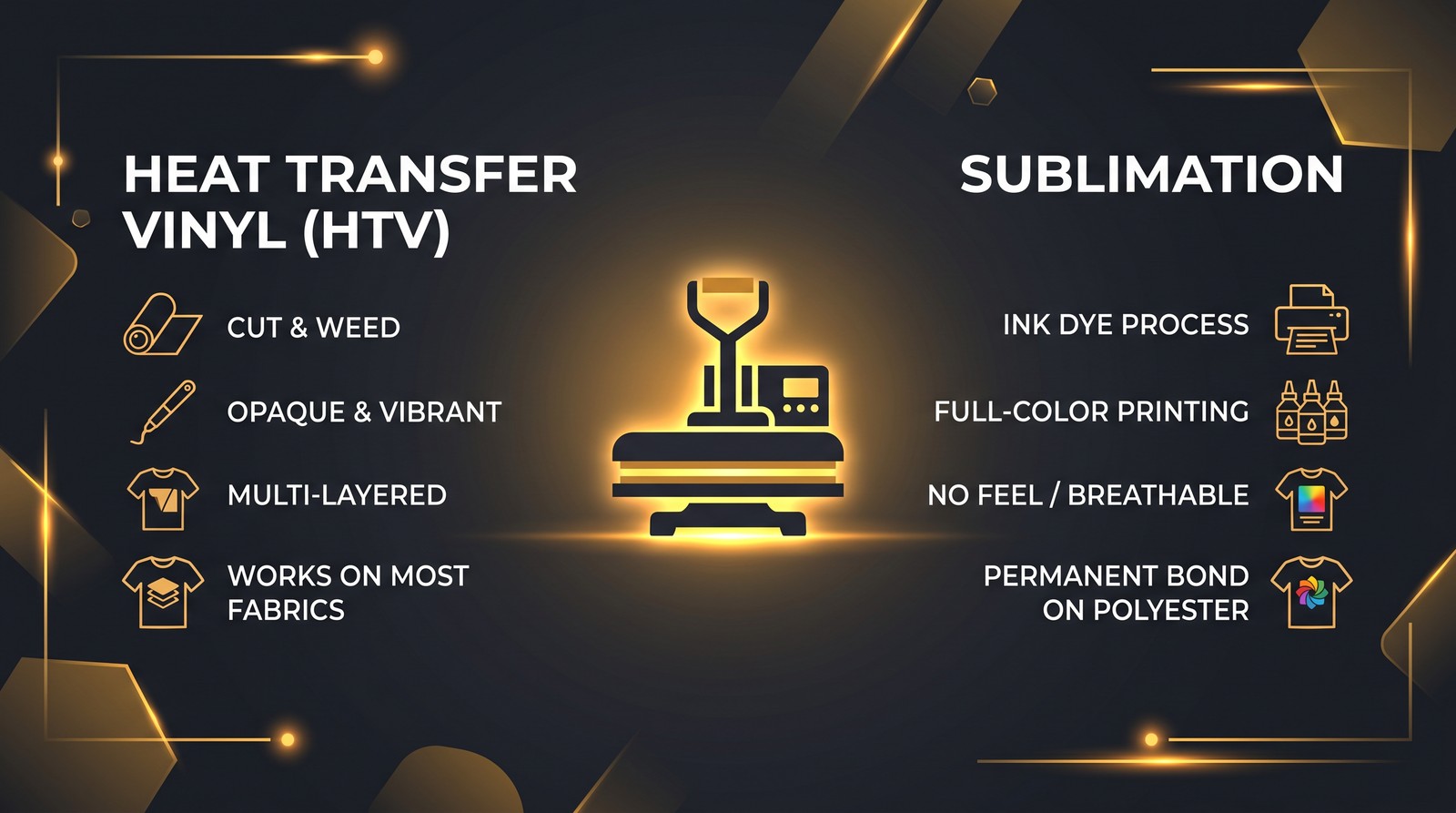
Most people asking about heat transfer vinyl vs sublimation are really asking a deeper question: which method won't waste my money?
We've watched sellers drop $1,000+ on sublimation gear only to realize they're printing five shirts a week on cotton. We've also seen HTV hustlers hit a ceiling where cutting and weeding 50 custom orders takes longer than the actual selling. The right answer depends entirely on your volume, your fabrics, and how much of the process you actually want to own.
Here's the breakdown we wish someone had given us before we bought our first heat press.
What Is Heat Transfer Vinyl vs Sublimation?
Both methods use a heat press. That's about where the similarities end.
HTV is a physical material you cut into shapes, weed out the excess, and press onto your garment. Think of it like a high-tech sticker for fabric. Sublimation is a chemical process where ink transitions from solid to gas and penetrates the fibers of polyester fabric, becoming part of the material itself.
The distinction matters because it dictates everything downstream: what fabrics you can use, how many colors you can print, how long the design lasts, and how fast you can scale.
How HTV Actually Works (And Where It Shines)
The HTV workflow is straightforward. You design your graphic, mirror-image it, cut it on a vinyl cutter (like a Cricut or Silhouette), weed away the excess vinyl, position it on your garment, and press it with a heat press at around 305-315°F for 10-15 seconds.
HTV's biggest advantage is fabric versatility - it works on cotton, polyester, blends, nylon, leather, and even wood.
That flexibility is why crafters and small custom shops love it. Someone orders a personalized name on a black cotton hoodie? HTV handles it. A sports team needs numbers on dark jerseys? HTV.
The tradeoff: every color in your design is a separate layer of vinyl. A three-color design means cutting, weeding, and layering three times. This is fine for simple text and basic graphics. It becomes a nightmare for photorealistic images or complex multi-color artwork.

The Real Cost of HTV
- Vinyl cutter: $200-$400 (Cricut Explore or Silhouette Cameo)
- Heat press: $150-$300
- HTV rolls: $5-$15 per roll (about 25-50 transfers per roll)
- Total startup: under $500
Per-unit cost depends on design complexity. A simple one-color name costs about $0.50-$1.00 in material. A multi-layer design with specialty vinyl (glitter, holographic, metallic) can run $3-$5 per shirt.
How Sublimation Printing Works (And Why Sellers Love It)
Sublimation is a completely different animal. You print your design onto special sublimation paper using sublimation ink, then press it onto a polyester substrate at 380-400°F for 45-60 seconds. The heat turns the ink into gas, which penetrates the polyester fibers and solidifies inside them.
The result is a print that literally becomes part of the fabric - no texture, no peeling, no cracking, ever.
That's sublimation's superpower. You can run your hand across a sublimated shirt and feel nothing but fabric. Try that with HTV and you'll feel the raised vinyl layer. After 50 washes, a sublimated print looks identical to day one. HTV starts showing wear at 25-30 washes.
The color capabilities are equally impressive. Since you're printing with CMYK ink, you get unlimited colors, smooth gradients, photorealistic images, and edge-to-edge coverage. No cutting, no weeding, no layering. Just print and press.
The Sublimation Catch
There's always a catch. Sublimation only works on polyester and polyester-coated substrates. Cotton? No. Dark fabrics? No. The ink needs polyester molecules to bond with, and on dark materials the white base color isn't there to make your design pop.
This single limitation is the reason both methods still coexist. If sublimation worked on cotton, HTV would be a niche hobby tool.
Equipment-wise, you need more upfront investment. A converted Epson EcoTank or dedicated Sawgrass printer runs $300-$800. Add sublimation ink ($50-$100), sublimation paper ($20-$40 for 100 sheets), and a quality heat press ($200-$500). You're looking at $600-$1,500 to get started.
Want to do this yourself? Merch Titans automates the entire process.
Head-to-Head: HTV vs Sublimation Compared
Durability: Sublimation Wins and It's Not Close
We need to be blunt here. If durability is your priority, sublimation wins by a wide margin.
Sublimation ink is literally inside the polyester fibers. There's nothing sitting on top of the fabric to crack, peel, or degrade. We've seen sublimated shirts go through 100+ wash cycles with zero visible fading. The print degrades at the same rate as the fabric itself.
HTV adhesive bonds to the surface of the fabric. It's durable enough for personal use - most quality HTV lasts 25-50 washes before showing signs of cracking or peeling at the edges. But if you're selling products and your reputation depends on longevity, that gap matters.
Quick durability rules:
- Sublimation: 50-100+ washes, no texture change, colors stay vibrant
- Quality HTV: 25-50 washes, some edge lifting possible, gradual cracking
- Cheap HTV: 10-20 washes before noticeable degradation
If you're comparing this to other methods, our sublimation vs screen printing breakdown covers how sublimation stacks up against the oldest method in the game.
Color and Design Complexity: Another Sublimation Landslide
For anyone doing complex artwork, sublimation is the only real option between these two.

Sublimation prints in full CMYK with millions of colors, smooth gradients, and photorealistic detail. A photograph, a watercolor painting, an intricate pattern - sublimation handles all of it in a single press.
HTV is layer-based. Each color is a separate piece of vinyl. Two colors? Two cuts, two weeds, two alignment steps. Five colors? You're spending 20-30 minutes per shirt just on prep. And forget about gradients or photographs - HTV is limited to solid colors and clean vector shapes.
This makes HTV ideal for:
- Text-based designs (names, quotes, numbers)
- Simple logos (1-3 colors)
- Sports jerseys and team uniforms
- Bold graphic shapes
And sublimation ideal for:
- All-over print designs
- Photographic prints
- Complex multi-color artwork
- Gradient and watercolor styles
- Patterns and repeating designs
For design creation tips that work with either method, check our guide on how to design t-shirts for print on demand.
Skip the Equipment Debate Entirely
Merch Titans automates your POD business so you can focus on designs, not heat presses.
Get Started Today →14-day money-back guarantee · Used by 150,000+ sellers since 2018
Fabric and Product Range: HTV Takes This One
Here's where HTV fights back. Hard.
HTV works on cotton, polyester, poly-cotton blends, nylon, spandex, leather, canvas, denim, and even wood and cardboard. Dark fabrics, light fabrics, textured fabrics. If you can press it, HTV probably sticks to it.
Sublimation is locked to polyester (minimum 65% poly content) and light-colored substrates. Dark polyester doesn't work because sublimation ink is translucent - there's no white ink layer to create contrast against a dark background.
This matters more than most guides acknowledge. The custom t-shirt printing market is still dominated by cotton and cotton-blend garments. If your customers want 100% cotton tees, sublimation simply isn't an option.
That said, sublimation expands beyond apparel into hard goods: mugs, phone cases, mousepads, puzzles, ornaments, coasters - anything with a polyester coating. For product diversification, sublimation opens doors that HTV can't.
The Scalability Problem Nobody Talks About
Here's the contrarian take that most comparison guides skip entirely.
Neither HTV nor sublimation scales efficiently for a solo entrepreneur. Both methods require you to be physically present, pressing garments one at a time, managing inventory, shipping orders, and dealing with returns on defective prints.
HTV hits a wall around 20-30 orders per day. The weeding alone becomes a full-time job. Sublimation is faster per unit but you're still limited by your heat press capacity and the time it takes to align, press, and quality-check each piece.
We watched a seller in our community build a sublimation business to 100 orders/day. They hired two employees, leased warehouse space, and bought three heat presses. Their margins were solid, but their life was consumed by production logistics.
Compare that to print on demand. No equipment. No inventory. No pressing shirts at midnight to meet orders. You create the design, list it, and a fulfillment partner handles everything from printing to shipping.
Which Method Should You Actually Choose?
Stop overthinking this. The decision tree is simpler than the YouTube videos make it look.
Choose HTV if:
- You do custom/personalized orders (names, numbers, one-offs)
- Your customers want cotton or dark-colored garments
- You're doing fewer than 50 units per week
- Your designs are text-heavy or 1-3 colors
- You want the lowest possible startup cost
Choose sublimation if:
- You want full-color, photorealistic prints
- You're building a product line on polyester
- You plan to expand into hard goods (mugs, cases, etc.)
- Volume exceeds 50 units per week
- Print durability is a key selling point
Choose print on demand if:
- You don't want to buy any equipment
- You want to test designs without inventory risk
- Scaling means uploading more designs, not buying more presses
- Your time is better spent on design and marketing than production
For a deeper dive into other printing methods, our DTG printing guide and custom t-shirt printing guide cover the full spectrum.
The Print on Demand Shortcut Most Sellers Miss
Here's what we keep coming back to with our users. The heat transfer vinyl vs sublimation debate assumes you want to own the production process. But the print on demand model has matured to the point where the quality gap between POD fulfillment and home production is negligible.
The real competitive advantage in 2026 isn't which heat press you own. It's how fast you can get winning designs in front of buyers.
That's the shift we built Merch Titans around. Instead of spending hours pressing shirts, you spend that time researching trending niches, creating designs, and scaling your listings across platforms. The production is someone else's problem.
We're not saying HTV and sublimation don't have their place. Custom shops doing personalized work need HTV. Sellers building branded product lines on polyester benefit from sublimation's quality. But for the vast majority of POD entrepreneurs trying to build a scalable business, owning production equipment is a distraction from the activities that actually grow revenue.
Merch Titans Automation
Build a POD Business Without a Single Heat Press
Merch Titans gives you the research, automation, and listing tools to scale - no equipment required.
14-day money-back guarantee · No contracts · Cancel anytime
The sellers making real money in this space aren't arguing about heat presses. They're uploading designs while everyone else is weeding vinyl. Which side of that equation do you want to be on?
Frequently Asked Questions
Is sublimation better than heat transfer vinyl?
Sublimation produces more vibrant, durable prints with unlimited colors and no texture on the fabric, making it superior for full-color designs on polyester. HTV is better for dark fabrics, cotton, and small-batch work where you need versatility over volume.
Which lasts longer - HTV or sublimation?
Sublimation prints last longer because the ink bonds permanently with polyester fibers at a molecular level, surviving 50+ washes without fading or cracking. HTV sits on top of the fabric and can crack, peel, or fade after 25-50 washes depending on quality and care.
Can you sublimate on cotton?
Standard sublimation does not work on cotton because sublimation ink requires polyester fibers to bond with. You can use cotton with special sublimation coating sprays or polyester-coated cotton blanks, but results are inconsistent and colors appear washed out compared to true polyester substrates.
Is HTV good for small businesses?
HTV is one of the most accessible printing methods for small businesses because startup costs are under $500, it works on virtually any fabric including cotton and polyester, and it is ideal for custom one-off orders and small batches where sublimation would be overkill.
What equipment do you need for sublimation?
A sublimation setup requires a sublimation printer (converted Epson or dedicated Sawgrass, $300-$800), sublimation ink ($50-$100), sublimation paper ($20-$40), and a heat press ($200-$500). Total startup cost ranges from $600 to $1,500 depending on equipment quality.
Which is more cost effective for beginners?
HTV is more cost effective for beginners with a total startup cost under $500 compared to $600-$1,500 for sublimation. HTV also has lower per-unit material costs for simple designs. However, sublimation becomes cheaper per unit at higher volumes because you are only paying for ink and transfer paper rather than pre-cut vinyl.