Most people overthink this. They hear "print on demand" and picture some complex manufacturing operation they need to understand before they can start selling. They research for weeks, watch 47 YouTube videos, and still feel like they're missing something.
Here's the reality: print on demand is one of the simplest business models in ecommerce, and understanding how it works takes about 10 minutes. The rest is execution. So let's break down exactly how does print on demand work, what happens behind the scenes when someone buys your product, and how you actually make money from it.
What Is Print on Demand?
Think of it as the opposite of traditional retail. Instead of buying 500 t-shirts upfront, storing them in your garage, and hoping they sell, you upload a design to a platform, and products only get created when someone actually pays for them. No order, no production. No production, no cost.
The print on demand business model has exploded over the past few years because it removes the single biggest barrier in ecommerce: financial risk. You don't need capital. You don't need a warehouse. You just need designs and a platform to sell them on.
How Does Print on Demand Work Step by Step?
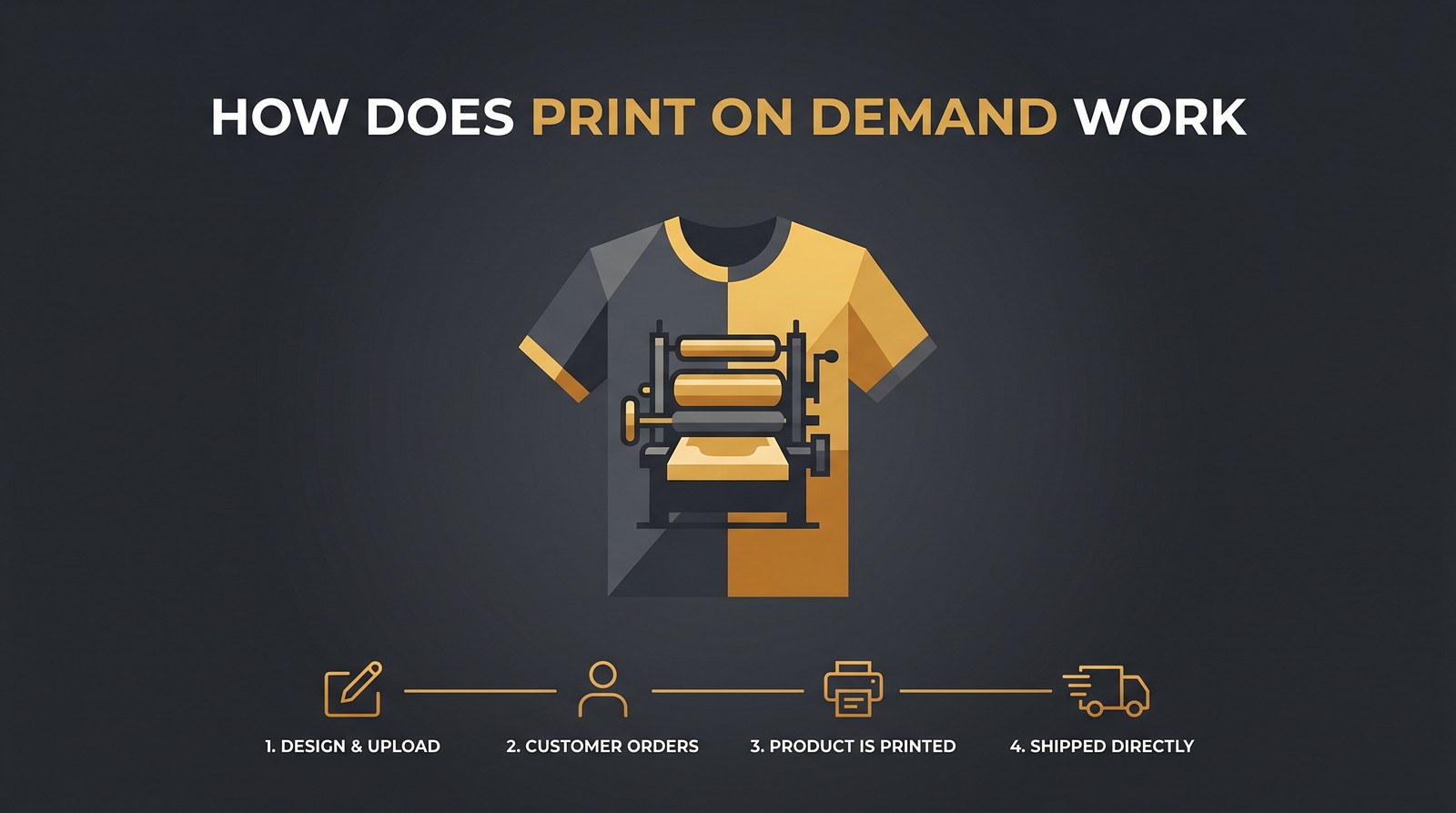
This is the core print on demand process from start to finish. Every POD business follows these five steps whether you're selling on Amazon, Etsy, or your own Shopify store.
-
You create a design. This can be text-based typography, graphic illustrations, AI-generated artwork, or anything that looks good on a product. Tools range from free options like Canva to professional software like Adobe Illustrator. The design file is typically a PNG with a transparent background at 300 DPI.
-
You upload the design to a POD platform. You pick the products you want to sell (t-shirts, hoodies, mugs, phone cases), position your design on each product mockup, write a title and description with relevant keywords, set your retail price, and publish the listing. Platforms like MyDesigns make this process fast because you can manage both physical POD products and digital products from one dashboard.
-
A customer finds and buys your product. They discover your listing through marketplace search, Google, social media, or paid ads. They see the product mockup, like the design, and place an order at your retail price. You get notified of the sale.
-
The fulfillment partner prints the product. This is where the "on demand" part happens. The POD platform's printing facility receives the order, pulls your design file, prints it onto the blank product using DTG (direct-to-garment) printing, sublimation, or screen printing depending on the product type. They quality-check it and package it for shipping.
-
The product ships directly to the customer. The fulfillment partner ships the finished product to the customer's address with your branding or the marketplace's branding. You never see or touch the product. The platform deducts the base cost (production + shipping) and you keep the difference as profit.
That's the entire print on demand workflow. Five steps, zero inventory, and the only thing you're responsible for is step one and two. Everything after the sale is handled for you.
The Money Part: How Print on Demand Profit Actually Works
Let's talk numbers because this is where print on demand explained in theory meets print on demand in practice.
Here's a realistic breakdown for a standard t-shirt on Amazon Merch on Demand:
| Cost Component | Amount |
|---|---|
| Your retail price | $19.99 |
| Amazon's base cost (production + fees) | $10.25 |
| Your profit per sale | $9.74 |
Your profit margin on a single t-shirt sale is roughly 49%, and you did zero manufacturing, zero shipping, zero customer service. That's the power of this model.
Now scale that. One design selling 3 units per day at $9.74 profit equals $29.22 daily, or about $876 per month. Get 10 designs performing at that level and you're looking at $8,760 per month. This is why print on demand profit margins matter so much, and why platform choice directly impacts your bottom line.
The sellers earning serious money aren't necessarily better designers. They're better at volume and optimization. They have hundreds or thousands of active listings, they research keywords, and they use tools to scale what would otherwise take months of manual work.
What Products Can You Sell with Print on Demand?
Print on demand isn't just t-shirts. The product catalog has expanded dramatically, and choosing the right products can make or break your margins.
High-Margin Products
- T-shirts and tank tops - The bread and butter. Highest volume, most competitive, solid margins.
- Hoodies and sweatshirts - Higher price points mean bigger absolute profit per sale ($12-20 per unit).
- Mugs and drinkware - Consistent sellers, especially for niche humor and workplace designs.
- Phone cases - Lower production costs, decent margins, but more size/model complexity.
Emerging Product Types
- All-over print apparel - Sublimation printing allows full-coverage designs. Higher perceived value.
- Home decor - Canvas prints, throw pillows, blankets. Higher price points.
- Stickers and accessories - Low cost, impulse buys, great for building a brand following.
The most profitable print on demand sellers diversify across product types rather than putting all their designs on t-shirts only. A single design can generate revenue across 5-10 product types with minimal extra work. When you create one winning design, applying it across mugs, hoodies, and phone cases takes minutes and multiplies your revenue without multiplying your creative workload.
Want to do this yourself? Merch Titans automates the entire process.
Where to Sell: Platforms That Handle Everything
Choosing the right platform is the single most important decision you'll make. Each one handles the fulfillment differently and takes a different cut.
Marketplace Platforms (Built-In Traffic)
Amazon Merch on Demand - The biggest marketplace in the world. You upload designs, Amazon handles everything from printing to shipping to customer service. The downside: it's invite-only with a tier system that limits how many designs you can upload until you prove yourself.
Etsy + POD Integration - Etsy's handmade marketplace paired with a print partner like Printify or Printful. You get access to Etsy's buyer base, but you manage the storefront and handle customer inquiries. Use our Etsy keyword research tool to find high-demand, low-competition niches.
Independent Platforms (Maximum Control)
MyDesigns is the platform we recommend for serious sellers who want full control. Unlike marketplace-dependent options, MyDesigns lets you sell both physical POD products AND digital products from one platform, keep the highest margins, and build a brand you actually own. No tier restrictions, no approval process, no marketplace algorithm deciding your fate.
Want to do this yourself? Merch Titans automates the entire process.
What It Actually Costs to Start (Spoiler: Almost Nothing)
One of the biggest misconceptions about ecommerce is that you need startup capital. Print on demand has the lowest barrier to entry of any legitimate online business model.
Here's the real cost breakdown:
| Expense | Cost | Required? |
|---|---|---|
| Design software (Canva free tier) | $0 | Yes (free option) |
| POD platform account | $0 | Yes (most are free to join) |
| Domain name (if own store) | $10-15/year | Optional |
| Merch Titans for scaling | $39.99/mo or $29.99/mo annual | Optional (when ready to scale) |
| Paid advertising | $0+ | Optional |
| Total minimum to start | $0 |
You read that right. You can start a print on demand business today without spending a single dollar. The decision of whether print on demand is worth it comes down to your willingness to put in the time, not money.
Ready to Scale Your POD Business?
Merch Titans gives you the automation tools to turn a side hustle into a real income stream.
Get Started Today →14-day money-back guarantee · Used by 150,000+ sellers since 2018
The Timeline: From Design to Delivery
People always ask how long does print on demand take. Here's the realistic timeline for what happens after a customer clicks "buy."
-
Order received (instant) - The POD platform's system receives the order and routes it to the nearest fulfillment center.
-
Production (2-5 business days) - The printing facility prints, quality-checks, and packages the product. DTG printing is fastest at 1-2 days. Sublimation and specialty products can take 3-5 days.
-
Shipping (3-7 business days) - Standard shipping via USPS, UPS, or regional carriers. International orders take longer, typically 7-14 business days.
-
Total delivery time: 5-12 business days - This is the main tradeoff vs. Amazon Prime's 1-2 day shipping for pre-stocked items.
The Honest Downsides (And Why They Don't Matter as Much as You Think)
We're not going to pretend print on demand is perfect. Here are the real tradeoffs, and our take on each one.
Lower margins than bulk wholesale. True. If you ordered 1,000 shirts from a manufacturer at $3 each and sold them at $20, your margin would crush POD. But you'd also need $3,000 upfront and a plan for the 600 shirts that might not sell. POD trades maximum margin for zero risk. For most sellers, that's the right trade.
You can't control product quality directly. You never hold the product before the customer gets it. This means you're trusting the fulfillment partner's quality standards. The fix: order samples of your own products periodically, and stick with reputable platforms.
Competition is real. Everyone knows about POD now. The bar for "upload a generic sunset design and make money" is gone. The sellers winning in 2026 are the ones treating POD like a real business: researching keywords, testing niches, and using automation to outpace manual sellers. This is exactly why we built Merch Titans - to give serious sellers an unfair advantage.
Shipping times can't compete with Prime. Covered above. Set expectations and it's a non-issue for most buyers.

How to Actually Start (The No-Fluff Version)
You've read 2,000+ words about how print on demand works. Here's exactly what to do next, in order.
-
Pick your starting platform. If you want built-in traffic and zero setup, apply for Amazon Merch on Demand. If you want full control and higher margins from day one, start with MyDesigns. You can always expand to multiple platforms later.
-
Create 10 designs in a niche you understand. Don't try to appeal to everyone. Pick a specific audience - nurses, dog owners, rock climbers - and create designs that speak directly to them. Use our Amazon keyword research tool to validate demand before you design.
-
Write keyword-optimized listings. Your title, bullet points, and description determine whether customers find your products. This is where most beginners fail. They create great designs and bury them with terrible titles.
-
Publish and iterate. Get your first 10 listings live. Study which ones get impressions, clicks, and sales. Double down on what works. Kill what doesn't.
-
Scale with automation. Once you've validated your niche and design style, the bottleneck becomes upload speed. This is where Merch Titans transforms your workflow. Instead of spending 15 minutes per listing, you push batches of optimized listings in minutes. That's the difference between 50 listings a month and 500.
For the full startup playbook, our guide on how to start a print on demand business goes deeper into each step.
The Bigger Picture: Why POD Is Still a Massive Opportunity in 2026
Here's the contrarian take most POD "gurus" won't tell you: the market isn't saturated. The low-effort market is saturated. There's a massive difference.
Sellers who treat print on demand as a keyword-driven, data-optimized business are thriving. They're not guessing which designs will sell. They're researching search volume, analyzing competition, and creating products that match proven demand. They're using AI tools for design generation and automation platforms for scaling.
The old playbook of "upload random designs and hope for sales" is dead. The new playbook is research, automate, and iterate. And the sellers who adopt that mindset today are the ones who will be earning $10K+ monthly by the end of this year.
Print on demand isn't a get-rich-quick scheme. It's a get-rich-systematically business if you treat it like one. The question isn't whether print on demand works. You now know exactly how it works. The question is whether you're going to start.
Merch Titans Automation
Stop Uploading Manually. Start Scaling.
Merch Titans automates the tedious parts of POD so you can focus on what actually makes money - finding winning designs and niches.
14-day money-back guarantee · No contracts · Cancel anytime
Frequently Asked Questions
How does print on demand work step by step?
Print on demand works in five steps: you create a design, upload it to a POD platform, a customer places an order, the fulfillment partner prints the product on demand, and they ship it directly to the customer. You collect the retail price minus the base cost as profit without ever handling inventory.
Is print on demand profitable?
Print on demand is profitable with typical profit margins ranging from 20% to 50% per sale depending on the product and platform. A single t-shirt design selling 5 units per day at a $10 profit margin generates $1,500 per month, and sellers with hundreds of active designs regularly earn $5,000 to $20,000 monthly.
How much money can you make from print on demand?
Print on demand earnings range from a few hundred dollars per month for casual sellers to $10,000 or more monthly for sellers running optimized catalogs of 500+ designs across multiple platforms. Top sellers using automation tools like Merch Titans to scale listings have reported six-figure annual revenues.
Do you need to invest money in print on demand?
Print on demand requires zero upfront inventory investment. The only costs are optional: design software ($0 to $20 per month), a POD platform subscription, and advertising if you choose to run paid promotions. Many sellers start with completely free design tools and organic traffic.
How long does print on demand take to ship?
Print on demand orders typically take 2 to 5 business days for production plus 3 to 7 business days for standard shipping, totaling about 5 to 12 business days from order to delivery. Expedited shipping options can reduce delivery to 3 to 5 business days total on some platforms.
What are the downsides of print on demand?
The main downsides of print on demand are lower profit margins compared to bulk wholesale, longer shipping times than pre-stocked inventory, limited quality control since you never handle the product, and high competition in popular niches. These tradeoffs are worth it for most sellers because POD eliminates the financial risk of unsold inventory.