The print on demand business model is the most misunderstood opportunity in ecommerce. Skeptics call it saturated. Beginners think it's passive income on autopilot. Both are wrong, and both misconceptions are costing people real money.
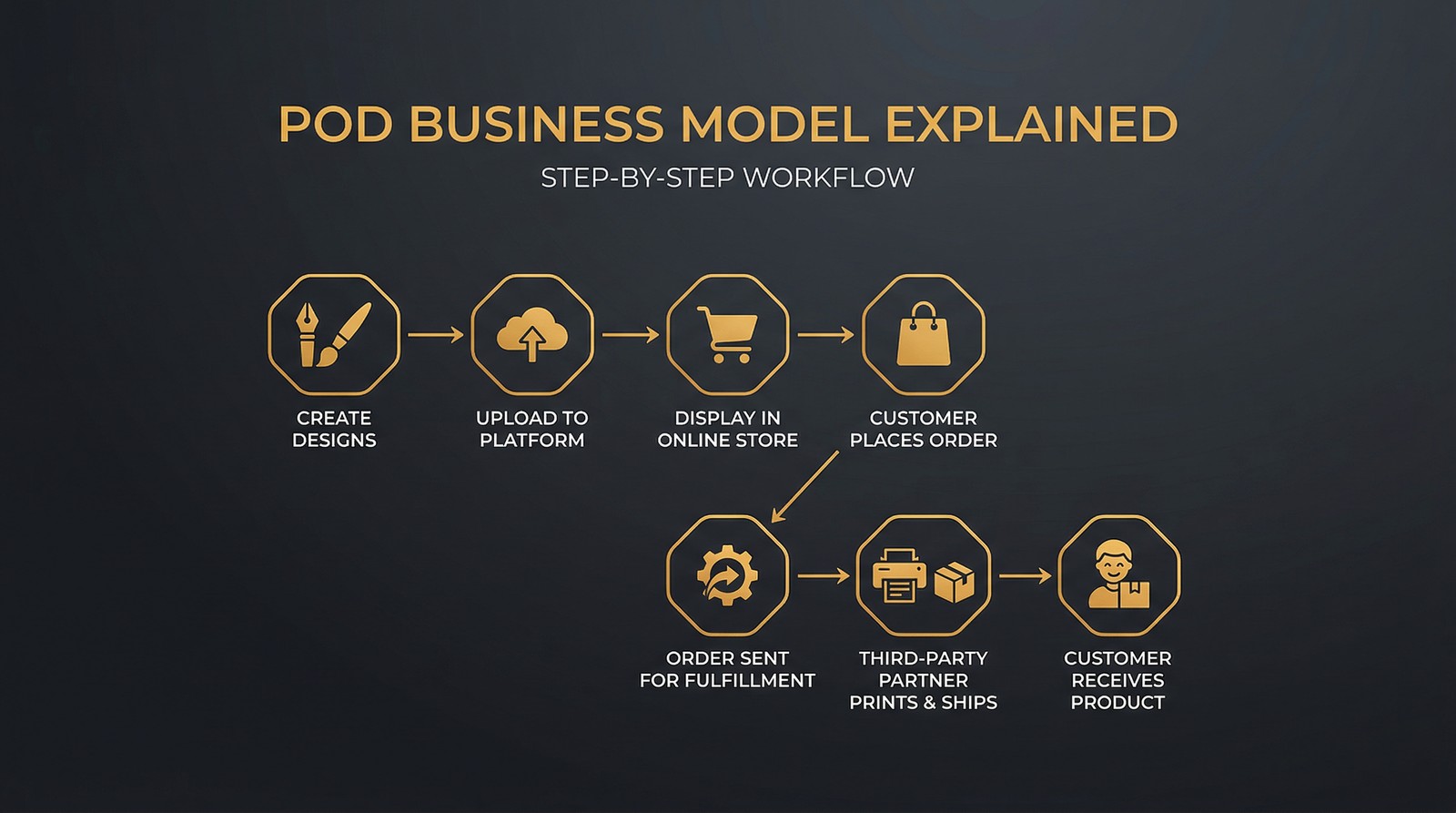
Here's what the print on demand business model actually is: you create designs, list them on products across online marketplaces, and when a customer buys, a third-party printer produces the item, packages it, and ships it directly to the buyer. You never touch inventory. You never pack a box. You collect the difference between retail price and production cost.
It sounds simple because it is. The barrier to entry is near zero. But the barrier to doing it well - that's where the money separates.
How the Print on Demand Business Model Works Step by Step
The mechanics are straightforward. Understanding the leverage points within each step is what matters.
Step 1: Create or Source Designs
Your designs are your product. Every design you create becomes a potential revenue-generating asset that can earn for months or years with zero additional effort.
Design sources include:
- Creating your own using tools like Canva, Photoshop, or AI generators (see our Canva POD guide)
- AI-generated designs that you refine and customize (best AI tools for POD)
- Freelance designers on Fiverr or Upwork ($5-$50 per design)
- Design templates from marketplaces you modify for niches
Step 2: List Products on Marketplaces
Each design gets applied to product templates (t-shirts, hoodies, mugs, phone cases) and listed with optimized titles, descriptions, and tags on selling platforms.
Key platforms:
- Amazon Merch on Demand - largest audience, zero ad spend needed
- Etsy - strong for gifts and unique items
- Shopify - build your own branded store
- MyDesigns - sell both physical POD products and digital design files
Step 3: Customer Purchases
A buyer finds your product through marketplace search, your marketing, or organic discovery. They place an order at your retail price.
Step 4: Automated Fulfillment
The POD supplier receives the order automatically, prints your design on the product, packages it, and ships it to the customer. You do nothing.
Step 5: You Collect Profit
The difference between your retail price and the production + shipping cost is your profit. Depending on the product and platform, that's typically $5-$25 per sale.
Why Print on Demand Beats Traditional Ecommerce
The print on demand business model eliminates the three biggest risks that kill traditional ecommerce businesses.
No Inventory Risk
Traditional ecommerce requires buying inventory upfront. Order 500 t-shirts and hope they sell. If your design flops, you're sitting on 480 unsold shirts in your garage. POD eliminates this entirely. Zero products are produced until a paying customer places an order.
No Fulfillment Overhead
Warehousing, packing, shipping labels, returns processing - none of that exists in a POD business. Your supplier handles the entire post-purchase experience. You focus on creating designs and marketing.
No Capital Requirements
Starting a traditional product business requires $5,000-$50,000+ for inventory, packaging, storage, and initial marketing. Starting a print on demand business requires a laptop, design software (free options exist), and a marketplace account.
Want to do this yourself? Merch Titans automates the entire process.
The Real Print on Demand Revenue Model: Where the Money Comes From
Most POD education focuses on per-unit profit. That's one piece. The real print on demand business model is a portfolio play.
The Long Tail Effect
Every design you list is a revenue asset. Some designs will sell once a month. Some will sell once a year. A few will sell multiple times per week. Individually, most designs generate modest income. Collectively, a catalog of 500-1000 designs creates a diversified revenue portfolio.
Think of it like a music catalog. No single song needs to be a massive hit. A thousand songs each earning $5/month equals $60,000/year.
Revenue Stacking Across Platforms
One design can generate revenue on multiple platforms simultaneously:
- Same design on Amazon Merch → earns from Amazon's traffic
- Same design on Etsy → earns from Etsy's gift buyers
- Same design on your Shopify store → earns the highest margin
- Same design as a digital file on MyDesigns → earns passive digital product revenue
A single design that earns $20/month across four platforms generates $240/year. Multiply that by 500 designs and you're looking at $120,000/year from designs you created once.
Realistic Income Expectations
| Catalog Size | Monthly Revenue (est.) | Time to Build |
|---|---|---|
| 50 designs | $100-$500 | 1-2 months |
| 200 designs | $500-$2,000 | 3-6 months |
| 500 designs | $2,000-$5,000 | 6-12 months |
| 1,000+ designs | $5,000-$15,000+ | 12-24 months |
These ranges assume proper keyword optimization, multi-platform distribution, and consistent niche targeting. Uploading 1,000 random designs without SEO strategy will underperform these benchmarks significantly.
Build Your Design Catalog Fast
Merch Titans' bulk upload and keyword research tools let you list optimized designs across platforms at 10x the manual speed.
Get Started Today →14-day money-back guarantee · Used by 150,000+ sellers since 2018
The Cost Structure Nobody Talks About
The print on demand business model is low-cost, not no-cost. Understanding the real cost structure helps you invest where it matters.
Fixed Costs (Monthly)
- Design tools: $0-$13/month (Canva free tier or Pro at $13)
- Marketplace fees: $0-$15/month (Etsy listing fees, Shopify plan)
- Automation tools: $29.99-$39.99/month (Merch Titans pricing - unlocks bulk upload, keyword research, trademark checking)
- Total fixed costs: $30-$70/month
Variable Costs (Per Sale)
- Production cost: Built into the retail price - paid only when you sell
- Platform commissions: 6-15% depending on marketplace
- Shipping: Usually included in production cost or paid by customer
The Breakeven Math
If your average profit per sale is $10 and your monthly fixed costs are $50, you need 5 sales per month to break even. With a catalog of 100+ optimized designs, hitting 5 sales per month is conservative.
The Competitive Advantages That Actually Matter in POD
Design talent is overrated in print on demand. The sellers who win consistently have these three advantages.
1. Speed of Execution
The seller who lists 100 designs this week beats the seller who perfects 10 designs this month. Volume creates data. Data reveals winners. Winners get doubled down on. This cycle is the engine of every successful POD business.
Automation tools are the speed multiplier. Uploading 100 designs to Amazon Merch manually takes a week. With the right tools, it takes an afternoon.
2. Keyword Research Depth
Your design is invisible without the right keywords. The seller who spends 15 minutes researching keywords for every design will outperform the seller with better designs and zero keyword strategy.
Every listing should start with keyword research:
- Amazon keyword research tool for Amazon Merch listings
- Etsy keyword research tool for Etsy listings
- Google keyword research tool for Shopify SEO
3. Multi-Platform Distribution
Single-platform sellers are leaving 70-80% of their potential revenue on the table. Every major marketplace has a different customer base with different buying intent. The same design can sell to completely different audiences on Amazon vs. Etsy vs. Shopify.
Our multi-platform strategy guide covers the exact workflow for distributing designs across platforms efficiently.
How Print on Demand Has Evolved in 2026
The POD business model in 2026 looks different from even two years ago. Three major shifts are reshaping the landscape.
AI Has Democratized Design
You no longer need to be a designer or hire one to create competitive POD designs. AI tools generate professional-quality designs in seconds. This has lowered the design barrier but raised the importance of niche selection and keyword optimization as differentiators.
Automation Has Become Mandatory
In 2024, you could manually manage a 200-design POD catalog. In 2026, the top sellers are running 1,000-5,000+ designs across multiple platforms. That scale is physically impossible without automation. Bulk upload tools, automated keyword research, and trademark checking have become infrastructure, not luxury.
Product Diversity Matters More
T-shirts used to dominate POD revenue. Now sellers who expand into hoodies, mugs, phone cases, stickers, and tote bags are capturing revenue that t-shirt-only sellers miss entirely.
The Biggest Myth About Print on Demand
"Print on demand is passive income."
No. It's not. Not at first.
Building a POD business requires active effort. Research, design creation, listing optimization, platform management, trend monitoring. The first 6-12 months are work.
What happens after you've built a catalog of 500+ optimized designs is closer to semi-passive. You'll still create new designs (maybe 5-10 hours per week), monitor performance, and adjust strategy. But the bulk of your revenue comes from designs you created weeks, months, or years ago.
That's not passive income. It's leveraged income. Every hour you invest creates an asset that earns without additional effort. The compounding effect of that over 12-24 months is where the real wealth builds.
Getting Started: The First 30 Days
If you're starting from zero, here's the exact sequence we'd follow.
Week 1: Set up accounts on Amazon Merch on Demand (apply early - there's a waitlist), Etsy, and MyDesigns. Research your first 3-5 niches using keyword tools.
Week 2: Create 20-30 designs across your chosen niches. Focus on text-based designs first - they're fastest to produce and test.
Week 3: List all designs across platforms with fully optimized titles, descriptions, and tags. Track which niches and keywords you've targeted.
Week 4: Analyze initial data. Which designs got views? Which niches show traction? Double down on winners and abandon losers.
Check our full beginner's guide to starting a POD business for the expanded version of this roadmap.
Merch Titans Automation
Launch Your POD Business the Smart Way
Merch Titans gives you keyword research, trademark checking, and bulk upload tools - everything you need to go from zero to profitable faster.
14-day money-back guarantee · No contracts · Cancel anytime
The print on demand business model isn't dying. It's maturing. The sellers who treat it like a real business with real systems are building real wealth. The ones waiting for the "perfect" time or the "perfect" design are watching from the sidelines while the market moves without them. Pick a niche, create designs, list fast, iterate based on data. The model works. The question is whether you will.
Frequently Asked Questions
Is print on demand a profitable business model?
Yes. Typical POD profit margins range from 20-50% per product. Sellers who build catalogs of 500+ designs across multiple platforms regularly generate $3,000-$10,000+ monthly with near-zero overhead costs.
How much does it cost to start a print on demand business?
Technically zero. Platforms like Amazon Merch on Demand and Etsy with POD integration let you start with no upfront inventory cost. Your only expenses are design creation and optional marketing spend.
What is the difference between print on demand and dropshipping?
Print on demand is a subset of dropshipping where products are custom-printed with your designs before shipping. Traditional dropshipping sells pre-made products from a supplier's existing catalog. POD gives you unique, branded products.
How long does it take to make money with print on demand?
Most sellers see their first sales within 2-4 weeks if they upload 50+ designs with proper keyword optimization. Reaching consistent four-figure monthly revenue typically takes 6-12 months of systematic effort.
Can you build a full-time income with print on demand?
Absolutely. The model scales because every new design is a potential passive revenue stream. Sellers with 1000+ optimized listings across platforms commonly earn full-time incomes with a few hours of weekly maintenance.