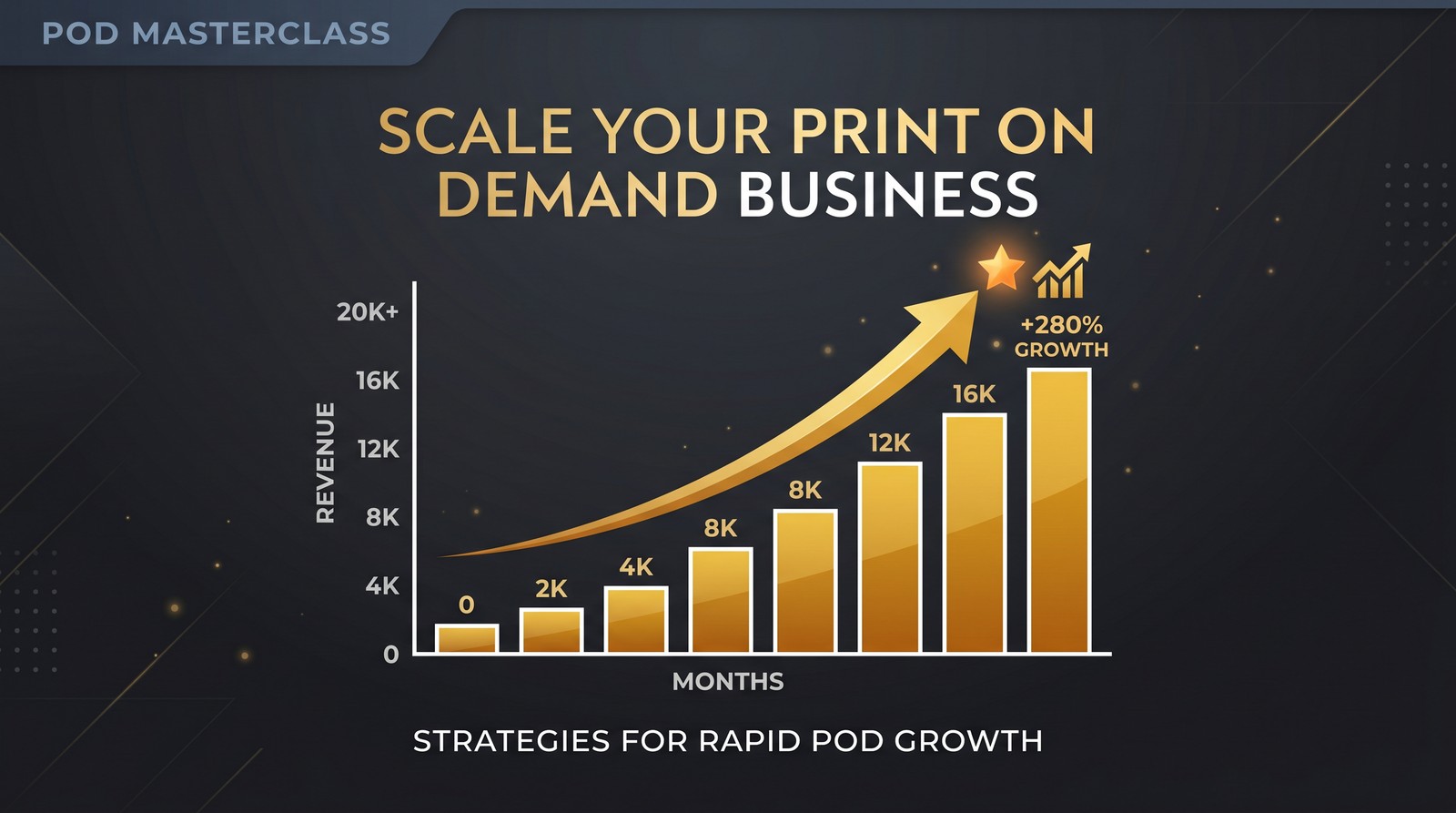
There's a clear ceiling in print on demand that most sellers hit around $500-$1,000/month. They're designing manually, uploading one listing at a time, and selling on a single platform. They're not growing. They're grinding.
The sellers at $10K, $20K, $50K/month aren't more talented. They're more systematic. They built leverage into every step of the process - design production, listing creation, platform distribution. And they did it early, before the grind became the business.
This is the scaling playbook.
What Does Scaling Print on Demand Actually Mean?
The key phrase is "without proportionally increasing time investment." If doubling your revenue requires doubling your hours, you haven't scaled. You've hired yourself for a second job.
True scaling means your revenue grows while your active hours stay flat or decrease. That's only possible when the bottlenecks - design production, listing creation, platform management - are handled by systems rather than manual labor.
The Three Scaling Bottlenecks (And How to Break Through Each)
Every POD seller who hits an income plateau is stuck at one of three places.
Bottleneck 1: Design Production
At 1-5 designs per day, you're manually creative-directing every product. That works at the hobby level. To get to 500+ listings across multiple niches, you need volume your solo creativity can't sustain.
The solution stack:
- AI image generation (Midjourney, Adobe Firefly, DALL-E 3) - Generate 10-20 design variations per hour instead of 1-2
- Design templates in Canva or Illustrator - Create a master template per product type, swap text/imagery for each niche variation
- Freelance designers on Fiverr or Upwork - Brief a designer with your style guide and order designs in batches of 20-50
- Design packs from services like Threadbasket - Ready-to-upload designs in proven niches
The goal: produce or acquire 20-50 designs per week consistently. That pace builds a 1,000+ listing library within a year.
Bottleneck 2: Listing Speed
Even with designs ready, uploading them one by one to multiple platforms kills your scaling momentum. Manual uploads to Etsy, Amazon, Redbubble, and Merch by Amazon take 15-30 minutes per listing. At that pace, 50 designs per week becomes 12-25 hours of pure upload work. That's not a business, that's a data entry job.
The solution: bulk upload automation.
Merch Titans reduces this from hours to minutes. You upload designs in bulk, write listings once using optimized templates, and the tool handles formatting and submission across platforms. Sellers using automation tools consistently report 10x listing velocity compared to manual processes.
The ROI math is straightforward: if automation tools cost $40/month and save 20 hours/week at even a modest $20/hour value of your time, that's $400/week saved for $40/month spent.
Want to do this yourself? Merch Titans automates the entire process.
Bottleneck 3: Platform Distribution
Selling on one platform creates a single point of failure. Amazon changes its algorithm, your sales crater. Etsy updates fees, your margins compress. One platform dependency is business fragility, not a business.
The multi-platform imperative:
Every design you create should live on multiple platforms simultaneously:
- Amazon Merch on Demand - Largest audience, passive royalties, no fulfillment overhead
- Etsy - High buyer intent, strong gift category traffic, direct customer relationships
- Redbubble/TeePublic - Passive income from the platform's own traffic
- MyDesigns - Highest profit margins, direct-to-consumer, full control over pricing and branding
- Shopify store - Long-term brand equity, email capture, custom product offerings
The same design that earns $0.75 on Redbubble might earn $5 on Etsy and $8 on your own Shopify store. Platform diversification doesn't just reduce risk - it multiplies revenue from the same creative asset.
The Numbers Game: Why Volume Wins in POD
POD is a portfolio business. Not every design sells. Not every niche catches. The sellers who try to pick winners before publishing are playing the wrong game.
The statistical reality: In a well-researched niche, roughly 1 in 10 to 1 in 20 designs will become a consistent seller. The rest break even or earn sporadically. This isn't failure - it's the business model.
The implication: to have 50 consistent sellers driving daily revenue, you need 500-1,000 published listings. At 20 designs/week, that's 25-50 weeks of consistent work. At 5 designs/week, that's 100-200 weeks. The math is unambiguous. Volume is the strategy.
This is why automation isn't optional - it's the only way to build the necessary volume without burning out.

Niche Strategy for Scale: Depth Over Breadth First
The counterintuitive scaling move: go deep in one niche before spreading wide.
A seller with 500 dog-themed products on Etsy will outsell a seller with 500 products spread across 50 niches. Here's why: niche depth builds algorithmic authority. Etsy and Amazon recognize you as a specialist in "dog mom" or "nurse gifts" and show your listings to more relevant searches.
The niche depth play:
- Pick one niche with proven demand (nurses, teachers, dog moms, firefighters, etc.)
- Build 100-200 listings in that niche across multiple product types (t-shirts, mugs, tote bags, phone cases)
- Develop 3-5 core design "families" that can be applied to multiple products
- Once that niche generates consistent daily sales, expand to an adjacent niche
We've watched sellers hit $3,000/month from a single well-developed niche before expanding. The foundation you build in one niche transfers: your Etsy seller score, your review velocity, your knowledge of what products in that niche sell at which price points.
Hiring and Delegation: How to Remove Yourself From the Bottleneck
The scaling ceiling you hit at $3,000-$5,000/month is often a personal capacity ceiling. You're the designer, the keyword researcher, the listing writer, and the customer service rep. One person can't do it all at scale.
The delegation roadmap:
-
First hire: Virtual Assistant (VA) - Train a VA on listing uploads and basic customer service. Platforms like OnlineJobs.ph provide reliable POD-experienced VAs for $4-8/hour. This buys back 15-20 hours/week immediately.
-
Second hire: Freelance designer - Remove yourself from design production for proven niches. Brief a designer with detailed style guides and niche requirements. Platforms: Fiverr, Upwork, or direct outreach to designers whose work you admire.
-
Third investment: Automation tools - Merch Titans for listing automation, scheduling tools for social media, email marketing platforms for customer nurturing. These tools are force multipliers for your team.
At this point, your role shifts from executor to operator. You're reviewing metrics, making niche decisions, and setting strategy - not manually uploading designs at midnight.
Merch Titans Automation
Stop Manually Uploading Listings
Merch Titans automates your POD workflow so you can scale without the grind. Start managing listings in bulk today.
14-day money-back guarantee · No contracts · Cancel anytime
Multi-Platform Expansion: The Revenue Multiplication Strategy
Once you have a winning product in one marketplace, replicate it everywhere immediately. The design is already paid for. The niche is validated. Distribution is the only remaining variable.
Platform expansion sequence:
- Start with Amazon Merch (validation - if it sells here, it sells anywhere)
- Launch the same design on Etsy (higher margins, direct customer relationships)
- Deploy to Redbubble and TeePublic (passive income from platform traffic)
- Create a MyDesigns product for the design (highest margins, your own brand)
- Build a Shopify store collection around your bestsellers (long-term brand equity)
This multi-platform approach means one winning design generates revenue across 5 channels simultaneously. The "work once, sell everywhere" model is what separates POD hobbies from POD businesses.
Pricing for Scale: Don't Race to the Bottom
New POD sellers consistently underprice, believing lower prices drive more sales. The data says otherwise.
Lower prices compress margins without proportionally increasing volume. A $19.99 t-shirt that earns $4 in profit requires 250 sales to hit $1,000. A $24.99 shirt earning $8 in profit requires 125 sales. The second scenario is easier to achieve because it requires half the customer volume.
The sustainable pricing model for scale:
- Entry-level products (standard tees, mugs): Price at the top 40% of your category
- Premium products (premium tees, hoodies, specialty items): 15-25% above average
- Bundles and custom orders: 2-3x the individual item price
Use competitive pricing as a floor, not a ceiling. When your designs are good and your listings are optimized, price signals quality - not just margin.

Analytics-Driven Scaling: Double Down on What Works
The biggest scaling mistake: treating every product and every niche equally. Some designs earn 80% of your revenue. Some niches convert at 3x the average rate. Without analytics, you can't see which is which.
Key metrics to track weekly:
- Sales by product/design - Identify top 20% of earners. Create design variations. Expand to new platforms.
- Sales by niche - Double production in high-converting niches. Stop investing in underperformers.
- Traffic sources - Where is your revenue actually coming from? Organic Etsy search? Amazon? Social media? Scale the top source.
- Conversion rate by listing - Low traffic + high conversion = needs more SEO. High traffic + low conversion = needs better mockups or pricing adjustment.
Review these monthly at minimum. The sellers who scale fastest aren't just publishing more - they're publishing more of what works, informed by data.
The path from $500 to $10,000/month in POD isn't about grinding harder. It's about building systems that multiply your output. Automation handles the repetitive work. Data tells you where to invest. Delegation removes you from execution and puts you in strategy.
Merch Titans is built specifically for this scaling phase. The bulk upload tools, keyword research integrations, and listing management features exist because we've watched hundreds of sellers hit the manual ceiling - and we built the tools to break through it.
Scale isn't a destination. It's a set of systems you build and maintain.
Frequently Asked Questions
How do I scale my print on demand business?
Scale your print on demand business by systematizing the three core bottlenecks: design production (use AI tools and freelancers to increase output), listing optimization (use bulk upload tools to go from 5 listings/day to 50+), and multi-platform expansion (replicate your winning products across Etsy, Amazon Merch, Redbubble, and your own store simultaneously).
How many designs do I need to make money on print on demand?
Most sellers see consistent daily sales starting at 100-200 optimized listings, with significant income ($1K+/month) becoming predictable around 500+ listings. Volume matters because POD is a numbers game - more listings in more niches creates more exposure and more sale opportunities across diverse buyer searches.
Can you make a full-time income from print on demand?
Full-time income from print on demand is achievable and documented across thousands of sellers, but it requires systematic scaling rather than casual posting. Sellers who treat POD as a business - building listing libraries of 500-2,000+ products across multiple platforms - regularly achieve $5,000-$20,000/month in revenue.
What is the fastest way to scale print on demand?
The fastest way to scale print on demand is combining AI design tools (for rapid design production) with bulk listing automation (for rapid publishing) and multi-platform deployment (publishing each design to 3-5 platforms simultaneously). This combination compresses what used to take months of work into days.
Should I use multiple print on demand platforms to scale?
Using multiple print on demand platforms is essential for scaling because each platform has different audiences, algorithms, and peak traffic periods. Selling the same design on Amazon Merch, Etsy, Redbubble, and your own store increases total exposure without increasing production costs - your design is created once and monetized everywhere.