Print on demand books have created more first-time six-figure authors than traditional publishing ever did. No agents. No publishers. No minimum print runs. No upfront costs. You create a book file, upload it, and a global distribution network handles everything from on demand book printing to shipping.
The POD books market hit $3.2 billion in 2025 and is growing at 12% annually. That growth is accelerating, not slowing. More readers are buying from independent authors, more niches are underserved, and the tools for self-publishing have never been more accessible or more powerful.
Whether you want to publish a novel, build a low-content journal empire, create children's books, or turn your expertise into a physical product, this guide covers every step of print on demand book publishing.
What Are Print on Demand Books?
The concept is identical to print on demand t-shirts and other POD products. No inventory. No bulk orders. No warehouse. A single copy is printed and shipped each time someone buys.
Traditional publishing requires ordering thousands of copies upfront. On demand book printing flips that model entirely. You upload a print-ready file, set your price, and the platform handles production, fulfillment, and customer service. Your only job is creating the content and driving sales.
The financial model works like this:
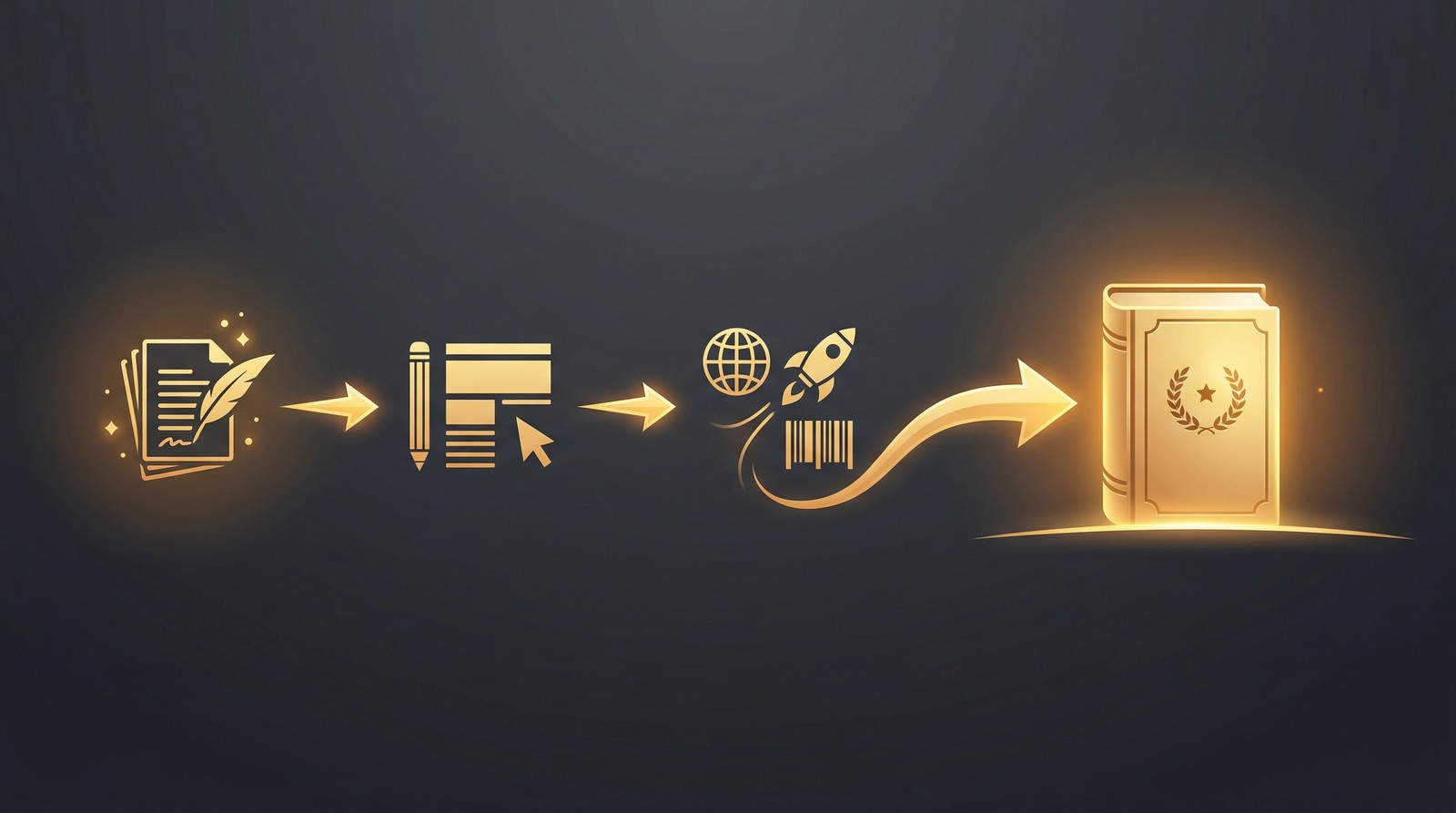
- You create the book - write the content, format the interior, design the cover
- You upload to a POD platform like Amazon KDP, IngramSpark, Lulu, or Blurb
- The platform lists it for sale on Amazon, through bookstores, or both
- A customer orders and the platform prints a single copy and ships it directly
- You get paid a royalty per sale, typically 30-60% of the list price minus print cost
Zero inventory risk. Zero upfront cost on most platforms. The financial model is identical to why print on demand is superior to traditional inventory.
The Best Print on Demand Book Platforms in 2026
Not all POD book platforms are equal. Each serves a different purpose, and most successful self-published authors use more than one.
Amazon KDP (Kindle Direct Publishing)
Amazon KDP is the dominant platform for print on demand book publishing, commanding over 80% of the self-published book market.
Why KDP wins for most publishers:
- Free to publish with no setup fees and no annual fees
- Your book appears on Amazon.com within 72 hours of approval
- Print quality is excellent, especially the premium color option launched in 2025
- Built-in marketing tools including Amazon Ads, A+ Content, and Kindle Countdown Deals
- Amazon handles all customer service, returns, and worldwide shipping
- Both eBook (Kindle) and paperback formats managed from one dashboard
- Print on demand hardcover books are now supported with case laminate covers
KDP print costs (approximate):
| Book Type | Page Count | Print Cost |
|---|---|---|
| B&W Paperback (6x9) | 100 pages | $2.50 |
| B&W Paperback (6x9) | 200 pages | $3.70 |
| B&W Paperback (6x9) | 300 pages | $4.90 |
| Color Paperback (6x9) | 100 pages | $5.50 |
| Color Paperback (6x9) | 200 pages | $8.50 |
| Hardcover (6x9) | 200 pages | $8.70 |
Royalty calculation: 60% of list price minus print cost for paperbacks sold on Amazon. A 200-page B&W paperback priced at $14.99 earns you ($14.99 x 0.60) - $3.70 = $5.29 per sale.
IngramSpark
IngramSpark is the industry standard for bookstore and library distribution. Owned by Ingram, the world's largest book distributor, it gives your POD book access to over 40,000 retailers, libraries, and online stores worldwide.
Why IngramSpark matters:
- Distribution to Barnes & Noble, independent bookstores, and libraries
- Returns program that lets bookstores order your books with reduced risk
- Higher-quality print options for color-heavy books and specialty formats
- Global distribution through Ingram's established network
The trade-off: IngramSpark charges $49 per title for setup. Print costs are comparable to KDP. You need your own ISBN.
The smart strategy is to use both. Publish on Amazon KDP for direct Amazon sales. Use IngramSpark for bookstore and library distribution. This dual-platform approach is standard practice for serious self-published authors who want maximum reach.
Lulu
Lulu offers more creative control over book formats than KDP or IngramSpark. Square books, horizontal orientation, specialty papers, and unique binding options are all available.
Best for: Art books, photography books, specialty children's books, cookbooks with unusual dimensions, and any project where standard trim sizes feel limiting.
Blurb
Blurb specializes in visual-heavy books where image quality is the top priority. Photo books, portfolios, art books, and coffee table books are Blurb's sweet spot. Their print quality for full-color, image-dense layouts is arguably the best in the POD book space.
Key features:
- BookWright (free layout software) makes design accessible to non-designers
- Trade books, magazines, and premium photo books all supported
- Integration with Amazon for distribution
- Print on demand hardcover options with dust jackets
Best for: Photographers, artists, and anyone creating visual portfolios or coffee table books.
BookBaby
Full-service publishing with editorial, design, and marketing packages. More expensive than DIY platforms but useful if you want professional help with cover design, interior formatting, and marketing strategy without hiring freelancers individually.

Want to do this yourself? Merch Titans automates the entire process.
Types of Print on Demand Books That Sell
The beauty of POD books is the range of formats you can publish. Each type has different skill requirements, profit margins, and time investments.
Low-Content and No-Content Books
This is where the print on demand mindset really shines. Low-content books require minimal writing. Think journals, planners, log books, puzzle books, and activity books.
Examples that sell consistently:
- Fitness tracking journals and workout logs
- Gratitude journals with daily prompts
- Blood pressure and glucose monitoring log books
- Composition notebooks for specific audiences ("cat lover composition notebook")
- Recipe journals and meal planners
- Password managers and address books
The keyword research approach here is identical to what works for POD t-shirts. Find niches with demand and low competition. The Amazon Keyword Research tool works for book keywords too, just set the domain to Amazon Books.
Coloring Books
Adult coloring books remain a massive category on Amazon. Stress relief themes, intricate patterns, nature scenes, and niche-specific designs (animals, mandalas, architecture) all sell well. You can use AI design tools to generate initial line art concepts and refine them manually.
The coloring book advantage: Once you create a winning template structure, producing new titles in different themes becomes a repeatable process.
Children's Books
Children's books are one of the highest-margin POD book categories because parents consistently pay premium prices. Picture books, early readers, and activity books for kids sell at $9.99 to $16.99 and cost only $3 to $5 to print in color.
Key considerations for children's books:
- Full-color interior is mandatory, which increases print costs
- Illustrations drive sales, so invest in quality artwork or use AI-assisted illustration workflows
- Board book format is not available through most POD platforms (stick to paperback and hardcover)
- Print on demand hardcover is ideal for children's books because parents expect durability
Photo Books
Photo books through Blurb and Lulu let photographers and visual creators sell physical portfolios without inventory. Wedding photographers, travel photographers, and food bloggers all use POD photo books as both products and portfolio pieces.
Sell your photo book templates and digital products on MyDesigns alongside the physical POD version for maximum revenue per customer.
Content Books (Non-Fiction)
You have knowledge someone will pay for. Put it in a book. Non-fiction in specific niches consistently generates passive income for years.
Hot categories right now:
- Business and self-improvement
- Health, wellness, and fitness
- Personal finance and investing
- Specific trade skills like welding, woodworking, and gardening
- Technology guides for non-technical audiences
A well-researched non-fiction book in a targeted niche can sell 50 to 200 copies per month for years. At $5 to $8 royalty per sale, that's $250 to $1,600 per month from a single title.
Fiction
Novels, short stories, poetry collections. Fiction is the hardest POD book model to monetize because discoverability depends heavily on marketing, reviews, and series momentum. But the upside is enormous.
The fiction formula: Write in a series. The first book is your funnel. Books 2 through 5 are where the money lives. Read-through rates of 40-70% on well-written series mean every new reader turns into 2 to 4 additional sales.
Print on Demand Hardcover: The Premium Play
Print on demand hardcover books deserve their own section because they represent one of the biggest opportunities most POD publishers overlook.
Amazon KDP added hardcover support in 2022, and it changed the economics. Hardcover books command retail prices of $24.99 to $39.99 without raising eyebrows. Print costs run $8 to $12 per copy, but the royalty math often works out better than paperback.
Hardcover royalty comparison (200-page B&W, 6x9):
| Format | Retail Price | Print Cost | Royalty (60%) | Your Earnings |
|---|---|---|---|---|
| Paperback | $14.99 | $3.70 | $8.99 | $5.29 |
| Hardcover | $27.99 | $8.70 | $16.79 | $8.09 |
Hardcover earns $2.80 more per sale than paperback in this example. And many readers prefer hardcover for non-fiction reference books, children's books, and gift purchases.
How to Self Publish Print on Demand Books: Step by Step
Step 1: Choose Your Niche and Validate Demand
Research demand before you create anything. Use the Google Keyword Research tool to find search volume for book-related queries. Check Amazon's Best Sellers lists in your target category to validate demand.
Validation checklist:
- Are there books selling in this niche? (Market exists)
- Are the top sellers' reviews less than perfect? (Room for improvement)
- Can you offer a unique angle or better content? (Differentiation)
- Is the niche evergreen or seasonal? (Determines long-term revenue)
Step 2: Create the Interior
For content books: Write in Google Docs, Scrivener, or Atticus. Format for print using Atticus (easiest), Vellum (Mac only), or Amazon's free KDP formatting tools.
For low-content books: Use Canva or Adobe InDesign. Create templates once, then produce dozens of variations by swapping themes, colors, and cover designs.
For coloring books and children's books: Create or source illustrations. Many designers use AI tools to generate initial concepts, then refine them for print quality.
Key formatting specs:
- PDF format, 300 DPI minimum
- Common trim sizes: 5x8, 5.5x8.5, 6x9, 8.5x11
- Include bleed if designs extend to page edges (0.125 inches on each side)
- No crop marks or registration marks in your uploaded file
Step 3: Design a Cover That Sells
Your cover sells the book. Period. The interior can be perfect, but a bad cover means nobody clicks.
Cover formula for non-fiction: Bold title, clean typography, single strong visual element, and a benefit-oriented subtitle. Don't try to be clever. Be clear.
Cover dimensions: Width = spine width + trim width + bleed. Use KDP's cover calculator to get exact dimensions based on page count and trim size.
Step 4: Handle Your ISBN
The ISBN decision is more strategic than most new publishers realize.
- KDP free ISBN: Locks distribution to Amazon only. Fine if you only plan to sell on Amazon.
- Your own ISBN from Bowker: $125 for one, $295 for ten. Required for IngramSpark. Gives you full control of your publishing imprint.
- IngramSpark also assigns ISBNs, but owning yours keeps your options open long-term.
Our recommendation: If you're publishing one book as a test, use KDP's free ISBN. If you're building a real publishing business, buy a block of 10 ISBNs from Bowker immediately.
Step 5: Upload and Publish
Amazon KDP upload process:
- Sign in to kdp.amazon.com
- Create a new title and select Paperback or Hardcover
- Enter metadata including title, subtitle, author name, description, and 7 keyword fields
- Upload your interior PDF and cover PDF
- Preview using the online tool and check for margin issues and text alignment
- Set pricing and select your royalty plan
- Publish, and your book goes live within 72 hours
Apply Your POD Research Skills to Every Product Type
The same keyword research and niche selection that drives book sales works for t-shirts, mugs, and every POD category. Merch Titans gives you the tools.
Get Started Today →14-day money-back guarantee · Used by 150,000+ sellers since 2018
Pricing Strategy for POD Books
Book pricing follows different psychology than apparel pricing. Readers have strong expectations based on category and format.
Non-fiction: $12.99 to $19.99 for most niches. Higher for specialized topics at $24.99 to $39.99 for professional or technical content. Price in line with top-selling competitors in your category.
Low-content books: $6.99 to $12.99. Journals and planners at $8.99 to $9.99 hit the sweet spot of perceived value and impulse purchase threshold.
Children's books: $9.99 to $14.99 for paperback, $16.99 to $24.99 for hardcover. Parents expect to pay more for children's books.
Fiction: $14.99 to $16.99 for paperbacks, $2.99 to $4.99 for Kindle editions. The Kindle version drives volume while the paperback provides higher per-unit royalty.
Print on demand hardcover pricing: Add $10 to $15 above your paperback price. Readers expect hardcovers to cost more, and the margin math supports it.
Marketing Your Print on Demand Books
Publishing is the easy part. Marketing separates pod books that sell from books that collect digital dust.
Amazon SEO Is Non-Negotiable
Amazon's search algorithm determines whether readers find your book. Optimize these elements:
- Title and subtitle: Include your primary keyword naturally
- 7 keyword fields: Fill all seven with relevant search terms actual readers use
- Categories: Choose two categories where you can realistically rank in the top 20
- Description: Benefit-driven copy with HTML formatting using bold text and lists
- A+ Content: Enhanced brand content with images and comparison charts after brand registration
Run Amazon Ads From Day One
Amazon's advertising platform lets you target specific keywords, competing books, and reader interests. Most successful self-published authors spend 20-40% of their revenue on Amazon Ads to maintain visibility. Start with automatic campaigns, analyze which keywords convert, then build manual campaigns around winners.
Build an Email List
The single most valuable marketing asset for a book author is an email list. Offer a free companion resource like a worksheet, checklist, or bonus chapter in exchange for email addresses. Every new book launch goes to your list first.
Cross-Promote Across Product Types
If you're already selling designs on Amazon Merch on Demand, your keyword research skills transfer directly to books. The same tools that help you find profitable niches for t-shirts work for finding underserved book niches.
The multiplier strategy:
- Publish a niche book on Amazon KDP
- Sell related t-shirt designs on Amazon Merch
- Sell digital templates and resources on MyDesigns
- Cross-promote everything so each product drives traffic to the others
One niche. Multiple product types. Multiple revenue streams. This is how print on demand profit actually scales.
Common Mistakes New POD Book Publishers Make
1. Writing the book before validating demand. Spend a weekend on keyword research before you spend a month writing. A book nobody searches for won't sell regardless of quality.
2. Ignoring cover quality. Budget $100 to $200 for a professional cover. It's the highest-ROI investment in your entire book project.
3. Publishing one book and waiting. POD books are a portfolio business. One book generates modest income. Twenty books in related niches generate life-changing income. Volume wins.
4. Skipping Amazon Ads. Organic discovery is increasingly competitive. Most successful POD book publishers run ads from day one to build initial ranking signals.
5. Using the free KDP ISBN when planning wider distribution. If you want bookstore distribution through IngramSpark later, you'll need your own ISBN anyway. Plan ahead and buy from Bowker upfront.
6. Not cross-selling across formats and platforms. Your book audience and your POD product audience overlap heavily. Sell the digital companion files on MyDesigns and the physical products through Merch and KDP simultaneously.
Your First 90-Day POD Book Action Plan
If you're starting from zero, here's the fastest path to your first print on demand book income:
- Use keyword research to find 5 underserved low-content book niches
- Design 3 to 5 journal or planner interiors using Canva templates
- Create professional covers or hire a designer for $50 to $100 each
- Publish all titles on Amazon KDP within the same week
- Run Amazon Ads at $5 per day per title for the first 30 days
- Analyze results at day 30, then double down on winners and cut losers
- Publish 5 more titles in month two based on what the data showed you
- By day 90, you should have 10 to 15 live titles generating $300 to $500 per month
Then expand into content books, coloring books, children's books, or fiction based on what resonates with your audience.
Merch Titans Automation
Your POD Skills Work Across Every Product Category
From books to t-shirts to home decor, Merch Titans gives you the keyword research and automation tools to dominate every print on demand category.
14-day money-back guarantee · No contracts · Cancel anytime
Print on demand books are not competing with traditional publishing anymore. They already won. The only question is whether you're going to be one of the publishers riding that wave, or one of the people still thinking about it a year from now.
Frequently Asked Questions
How much does it cost to print a book on demand?
Print on demand book printing costs range from $2 to $8 per copy depending on page count, trim size, and binding type. A standard 200-page 6x9 paperback costs approximately $3.50 to $4.50 through Amazon KDP or IngramSpark. You pay nothing upfront because costs are deducted from each sale automatically.
What is the best print on demand platform for books?
Amazon KDP is the best starting point for print on demand book publishing because it offers free setup, access to Amazon's massive marketplace, and competitive print costs. For wider distribution to bookstores and libraries, IngramSpark is the industry standard. Most serious authors use both platforms simultaneously.
Can you make real money with print on demand books?
Self-published POD book authors regularly earn $1,000 to $10,000 or more per month. Revenue depends on niche selection, catalog size, and marketing effort. Low-content books like journals and planners offer the fastest path to initial income because you can publish dozens per month without writing thousands of words.
Do you need an ISBN for print on demand books?
Amazon KDP provides a free ISBN for paperbacks sold on Amazon, but that ISBN locks you into Amazon-only distribution. For wider distribution through IngramSpark or bookstores, purchase your own ISBN from Bowker at $125 for one or $295 for ten. Owning your ISBN gives you full control over your publishing imprint.
How long does on demand book printing and shipping take?
Amazon KDP prints and ships books within 2 to 5 business days for domestic US orders. IngramSpark orders typically take 5 to 10 business days. Because print on demand books are manufactured only when ordered, there is no pre-printed inventory sitting in a warehouse.
Can you print hardcover books on demand?
Amazon KDP now supports print on demand hardcover books with case laminate covers. Hardcover print costs run approximately $8 to $12 per copy depending on page count, but the higher retail price point ($24.99 to $39.99) can actually deliver better per-unit royalties than paperbacks. IngramSpark and Blurb also offer hardcover POD options.