Most people who fail at print on demand never had a business model problem. They had an execution problem.
They picked a random niche, uploaded a handful of designs, waited for sales that never came, and declared POD "saturated." Meanwhile, sellers running the same print on demand business model with the right systems are quietly scaling to five and six figures per year. The difference is not talent or creativity. The difference is understanding how the model actually works and building systems around it.
This guide breaks down the entire print on demand business model from first principles. Not theory. Not hype. The actual mechanics of how money moves, where margins hide, and how smart sellers build real businesses on top of POD infrastructure.
What Is the Print on Demand Business Model?
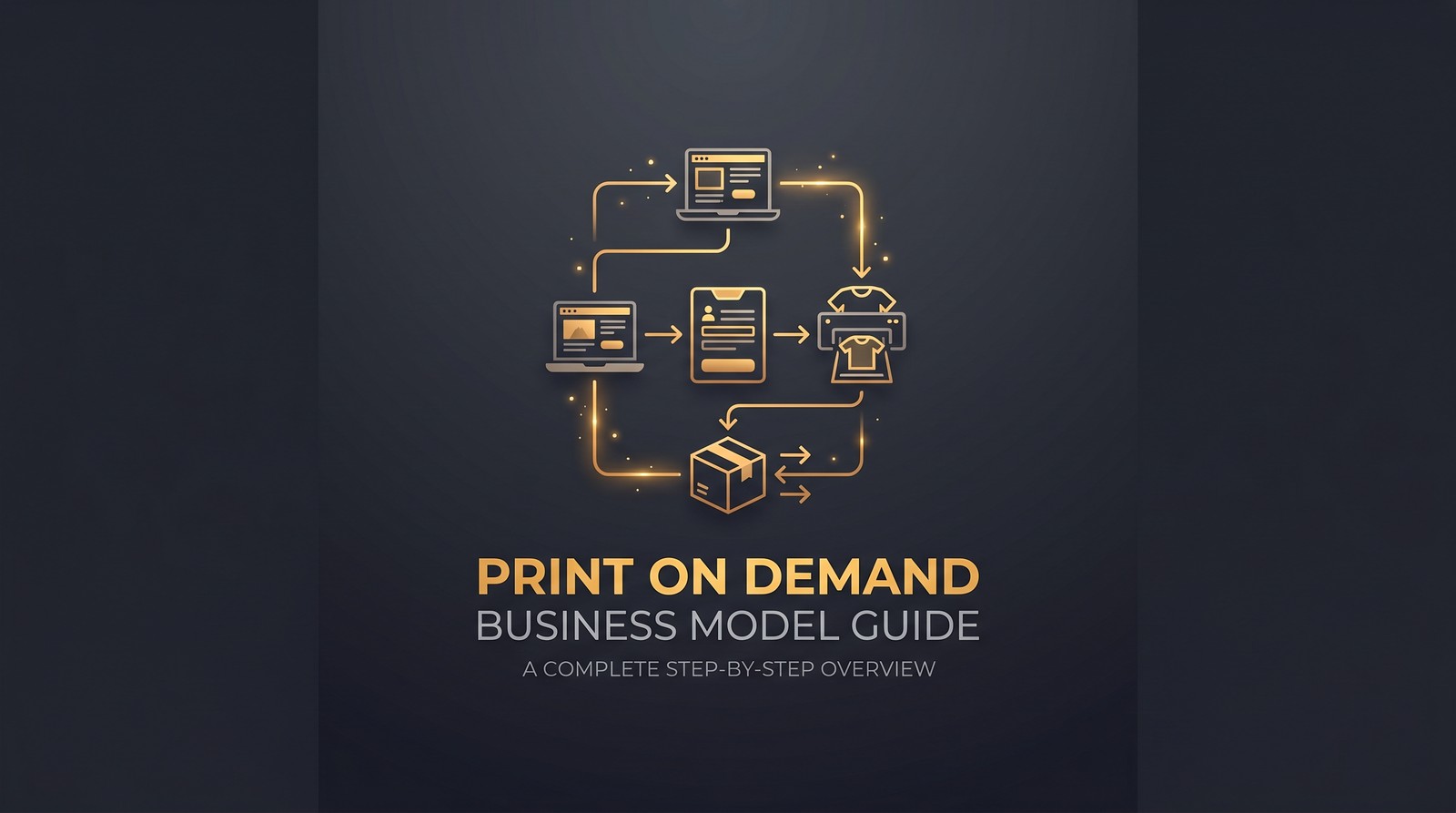
Here is how the cycle works in practice. You create a design. You upload it to a platform or marketplace. A customer finds your listing, likes the design, and buys. Only then does a fulfillment partner print that design onto a product - a t-shirt, mug, phone case, poster, whatever - and ship it directly to the customer. You never touch the product. You never see it. You collect the margin between what the customer paid and what production plus shipping cost.
This is fundamentally different from traditional retail or even standard ecommerce. There is no warehouse. No minimum order quantity. No dead stock collecting dust. Your only real investment is time spent on design creation and listing optimization.
The print on demand business model is also infinitely scalable in a way physical inventory businesses are not. Adding your 1,000th SKU costs the same as adding your first: zero dollars in inventory. That scalability is why POD has become one of the fastest-growing segments of ecommerce, projected to exceed $65 billion globally by 2030.
How Money Actually Moves in Print on Demand
Understanding the revenue flow is the first step to building a profitable print on demand business model. Too many sellers focus on design and ignore the economics.
Here is the simplified chain:
- Customer pays retail price (e.g., $24.99 for a t-shirt)
- Platform or marketplace takes a cut (varies: Amazon royalty structure vs. Shopify transaction fees)
- Fulfillment partner charges base cost (e.g., $8 to $13 for a standard tee)
- Shipping is either built into the price or charged separately
- You keep the remainder (your profit margin)
On Amazon Merch on Demand, the royalty structure is fixed. You set the list price, Amazon deducts production costs and their fee, and you receive the royalty. Typical royalties range from $2 to $8 per shirt depending on your price point.
On a standalone storefront like MyDesigns, you control the entire pricing stack. Sellers on MyDesigns routinely capture 40% to 60% margins because there is no marketplace middleman taking a cut. You pay only the fulfillment cost and a small transaction fee, keeping the rest.
This hybrid approach is not just about margin. It is about building an asset. An Amazon Merch account is rented space. A storefront on MyDesigns with an email list and brand identity is something you own.
Why Print on Demand Beats Traditional Ecommerce for New Sellers
We are not going to pretend POD is the only ecommerce model worth pursuing. But for new sellers in 2026, the print on demand business model has structural advantages that are hard to ignore.
Zero inventory risk. Traditional ecommerce requires buying inventory upfront. If your products do not sell, you eat the cost. POD flips that equation completely. You never buy a single unit that a customer has not already paid for.
Unlimited product testing. Want to test 500 designs across 20 niches this month? Go ahead. Each new listing costs you nothing but time. Try doing that with physical inventory and you will burn through your capital before you find a winner.
Location independence. The entire print on demand business model runs digitally. Design, upload, optimize, repeat - from anywhere with an internet connection. No warehouse lease, no shipping station, no employees.
Speed to market. A new design can go from concept to live listing in under 10 minutes with the right tools. We have watched sellers using Merch Titans' automation tools push over 100 optimized listings live in a single afternoon. That kind of speed is impossible with traditional retail.
Want to do this yourself? Merch Titans automates the entire process.
The tradeoff? Lower margins per unit compared to buying wholesale. But the zero-risk, infinite-SKU nature of POD more than compensates when you play the volume game correctly.
Choosing the Right Platform for Your Print on Demand Business
Platform selection is the single highest-leverage decision in your print on demand business model. It determines your margin ceiling, your traffic source, and your operational complexity.
Amazon Merch on Demand
The 800-pound gorilla. Amazon's built-in traffic means your designs are instantly visible to millions of shoppers who are already searching with buying intent. The tier system (you start at Tier 10 and scale up based on sales) creates a natural growth ramp.
Pros: massive organic traffic, zero marketing spend needed, trusted checkout. Cons: lower royalties, no customer data, Amazon controls everything. Check our guide on strategies for moving up tiers quickly if you are starting on Merch.
MyDesigns
MyDesigns is where serious POD sellers go for maximum control. Unlike Amazon, you own your storefront, your customer relationships, and your pricing. MyDesigns lets you sell both physical POD products and digital products (design files, templates, mockups) from a single platform, which is a massive revenue diversifier that no other POD platform offers.
Pros: highest margins in the industry, physical and digital products, full brand control, customer email capture. Cons: you need to drive your own traffic (which is where SEO and content marketing come in).
Other Marketplaces (Etsy, Redbubble, etc.)
Useful as supplemental channels but not where you want to build your foundation. Etsy has decent organic traffic but increasing fees and platform risk. Redbubble and similar sites have low margins and limited control. Use our Etsy keyword research tool and Redbubble tag generator to optimize listings if you are on those platforms.
The Real Cost Breakdown: Starting a Print on Demand Business
One of the biggest draws of the print on demand business model is the low barrier to entry. But "low cost" does not mean "no investment." Here is an honest breakdown of what it takes.
The $0 Path
You can genuinely start with nothing. Amazon Merch on Demand is free to join (application-based). Free design tools like Canva or GIMP work for basic designs. Free keyword research exists through Amazon's autocomplete and our Amazon keyword research tool.
The $100 to $300 Path (Recommended)
This is where most successful sellers start:
- Design software: $0 to $20/month (Canva Pro or Affinity Designer one-time purchase)
- Keyword research tools: $0 to $40/month (Merch Titans at $39.99/month covers keyword research, trademark checking, and automation)
- Domain name: $10 to $15/year for your storefront
- Learning resources: $0 (free tutorials, YouTube, our tutorials section)
The single best investment a new POD seller can make is a research and automation tool. The time savings compound exponentially. A seller spending 10 minutes per listing manually versus 30 seconds per listing with Merch Titans automation will have 20x more live listings in the same time period. More listings means more organic impressions, more sales, and faster tier progression.
The $300 to $500 Path
Everything above, plus:
- Paid design assets: $50 to $100 for premium fonts, graphics packs, or templates
- Marketing budget: $100 to $200 for initial social media ads or influencer outreach
- Professional mockups: $30 to $50 for high-quality product photography templates

Automate Your POD Research and Uploads
Merch Titans gives you keyword research, trademark checking, and bulk automation in one platform. Start scaling faster.
Get Started Today →14-day money-back guarantee · Used by 150,000+ sellers since 2018
Building Your Print on Demand Revenue Engine
Here is where we get tactical. The print on demand business model has four distinct revenue levers, and the best sellers pull all of them.
Lever 1: Volume of Live Listings
More listings equal more surface area for organic search. This is simple math. A seller with 5,000 optimized listings will generate more impressions, clicks, and sales than a seller with 50 listings, all else being equal. Volume is the foundational lever of every successful print on demand business model.
The key word is "optimized." Uploading 5,000 listings with garbage titles and no keyword research is a waste of time. Each listing needs a keyword-rich title, relevant bullet points, and proper categorization. This is where automation tools become essential. Manually optimizing 5,000 listings would take months. With Merch Titans' bulk upload capabilities, you can get it done in days.
Lever 2: Niche Selection and Keyword Targeting
Not all niches are equal. A design targeting "funny cat shirts" competes against millions of listings. A design targeting "funny radiology tech cat shirts" competes against dozens. The print on demand business model rewards specificity over broad appeal. Long-tail niches convert better because buyers searching niche terms have higher purchase intent.
Use keyword research to find niches with decent search volume (500+ monthly searches) and low competition. Our Amazon keyword research tool and Google keyword research tool are built exactly for this workflow.
Lever 3: Design Quality and Differentiation
You do not need to be a professional designer. But your designs need to pass the "would I actually wear this?" test. Clean typography, balanced composition, and a clear message beat complex illustrations nine times out of ten. Need inspiration? Check our collection of print on demand design ideas.
Lever 4: Multi-Channel Distribution
Every additional platform you list on is a free revenue multiplier. The same design uploaded to Amazon Merch, MyDesigns, Etsy, and Redbubble can generate sales from four completely independent traffic sources. The marginal cost of listing on additional platforms is near zero, especially with automation.
Scaling Your Print on Demand Business: From Side Hustle to Full-Time
The transition from "I make a few sales a month" to "this is a real business" happens when you stop treating POD as a creative hobby and start treating it as a system.
Phase 1: Foundation (Months 1 to 3)
- Upload 200 to 500 optimized listings across your primary platform
- Test 5 to 10 niches with 20 to 50 designs each
- Track which niches and design styles generate sales
- Reinvest early profits into tools and design assets
- Build your MyDesigns storefront in parallel
Phase 2: Optimization (Months 3 to 6)
- Double down on winning niches (your top 20% of designs generating 80% of revenue)
- Kill underperformers ruthlessly - remove or rework listings with zero sales after 90 days
- Expand to secondary platforms (Etsy, Redbubble) with your proven designs
- Start building an email list through your MyDesigns storefront
- Scale to 1,000+ live listings
Phase 3: Acceleration (Months 6 to 12)
- Automate everything possible - research, uploads, analytics
- Hire freelance designers to increase design output without increasing your time
- Launch seasonal campaigns ahead of major holidays (plan 60 to 90 days in advance)
- Start content marketing (blog, social media, YouTube) to drive traffic to your storefront
- Target 5,000+ live listings across all platforms
Phase 4: Brand Building (Year 2+)
- Develop signature design styles that customers recognize
- Build a direct-to-consumer brand through MyDesigns with recurring customers
- Add digital products (design templates, mockups, resources) to your MyDesigns storefront
- Consider expanding into adjacent products (stickers, home decor, accessories)
- Use your brand equity to negotiate better fulfillment rates

The Biggest Mistakes That Kill Print on Demand Businesses
We have worked with thousands of POD sellers through Merch Titans. The failure patterns are remarkably consistent.
Mistake 1: Treating POD as passive income from day one. The print on demand business model can become semi-passive over time, but the building phase requires real work. Uploading 10 designs and expecting passive income is delusional.
Mistake 2: Ignoring keyword research. Your designs do not matter if nobody can find them. A mediocre design with perfect keyword targeting will outsell a masterpiece with no SEO every single time. Use the trademark checker too - one IP violation can tank your entire account.
Mistake 3: Platform dependency. Putting 100% of your business on Amazon Merch is risky. Amazon can change royalty rates, suspend accounts, or alter the algorithm overnight. Diversify across platforms from the start.
Mistake 4: Manual everything. Sellers who refuse to invest in automation tools cap their own growth. The math is brutal. At 10 minutes per manual listing, you can upload 6 listings per hour. With automation, you can push 50 to 100+ in the same time. Over a year, that difference compounds into thousands of additional listings and thousands of dollars in revenue.
Print on Demand in 2026: What Has Changed and What Is Coming
The old print on demand playbook - upload random designs, pray for sales - is dead. Here is what is actually working now.
AI-assisted design is table stakes. Sellers using AI tools for design ideation and creation are producing higher-quality output at 10x the speed. This does not replace creativity, but it amplifies it. The sellers who resist AI tools are already falling behind.
SEO sophistication is rising. Five years ago, stuffing keywords into titles was enough. Today, Amazon's A10 algorithm and Google's search updates reward relevance, engagement metrics, and listing quality. The print on demand business model in 2026 demands real keyword strategy, not keyword stuffing.
Multi-platform is mandatory, not optional. The sellers we see thriving are on three to five platforms simultaneously. Amazon Merch for volume, MyDesigns for margins, Etsy for the handmade crowd, and emerging marketplaces for early-mover advantage.
Digital products are the margin multiplier. Platforms like MyDesigns let you sell digital downloads - design files, templates, fonts, mockups - alongside physical POD products. Digital products have near-100% margins and zero fulfillment complexity. Smart sellers are building hybrid catalogs.
The print on demand business model is not getting easier. It is getting more sophisticated. The bar for entry is still low, but the bar for success keeps rising. Sellers who invest in the right tools, build real systems, and treat this like a business will continue to win. The ones uploading random designs without strategy will continue to wonder why POD "does not work."
The model works. The question is whether you will work the model.
Merch Titans Automation
Ready to Build Your Print on Demand Business the Right Way?
Merch Titans gives you the research, automation, and speed to compete with the top 1% of POD sellers. No free trial needed - results speak for themselves.
14-day money-back guarantee · No contracts · Cancel anytime
Frequently Asked Questions
Is printing on demand profitable?
Print on demand is profitable when you focus on niche selection, SEO-driven traffic, and platform choice. Typical profit margins range from 20% to 60% per sale depending on the product and fulfillment partner. Sellers who automate research and uploads with tools like Merch Titans consistently outperform manual sellers because speed compounds into more listings, more organic impressions, and more sales.
Do I need an LLC for a print-on-demand business?
An LLC is not legally required to start a print on demand business, but forming one is strongly recommended once you generate consistent revenue. An LLC separates your personal assets from business liabilities and gives you tax flexibility. Most POD sellers operate as sole proprietors initially and form an LLC once monthly revenue exceeds $1,000 to $2,000.
How much does it cost to start a print on demand business?
Starting a print on demand business costs $0 to $500 depending on your approach. The POD model itself requires zero inventory investment. Your only costs are optional: a domain name ($10 to $15/year), design software ($0 to $20/month), keyword research tools, and marketing spend. Many sellers start with completely free platforms like Amazon Merch on Demand and reinvest early profits into tools and paid traffic.
What is the best print on demand business model?
The best print on demand business model combines marketplace listings on Amazon Merch on Demand with a standalone storefront on MyDesigns for maximum margin capture. This hybrid approach gives you Amazon's massive organic traffic for discovery while MyDesigns lets you keep 80% or more of each sale on direct orders. Diversifying across channels protects you from platform dependency and builds a real brand asset.