Most print on demand sellers leave money on the table by only designing t-shirts. Sweatshirts consistently deliver higher profit per sale, higher perceived value, and stronger customer loyalty. Yet the design process is almost identical.
The real difference between a $12 t-shirt profit and a $25 sweatshirt profit comes down to understanding print placement, fabric behavior, and which platforms actually move sweatshirt volume. We're going to break down every step.
What Is Custom Sweatshirt Design?
This covers everything from picking the right blank garment to formatting your design files, choosing print areas, and listing the finished product on platforms where buyers are actively searching. Unlike traditional screen printing, print on demand sweatshirt design eliminates minimum orders and upfront inventory costs completely.
The category is growing fast. Search volume for "custom sweatshirts" sits at 18,100 monthly searches, with seasonal spikes pushing well above 30,000 in Q4 and Q1. That's real buyer intent, not just curiosity.
For sellers already working in the print on demand space, sweatshirts represent one of the easiest product expansions you can make. Your existing designs often translate directly, just with adjusted file specs and print area awareness.
Why Sweatshirts Beat T-Shirts for POD Profit
Here's the math that most sellers ignore. A t-shirt on Amazon Merch on Demand retails for $18-$22 and nets you $4-$7 in royalties. A sweatshirt retails for $35-$50 and nets you $8-$15. Same design, same upload effort, double the profit.
Sweatshirts also benefit from stronger seasonal demand. While t-shirts sell year-round at relatively flat rates, custom sweatshirts see massive volume spikes:
- October-November: Back-to-school, college teams, holiday gift shopping
- December-January: Christmas gifts, New Year resolutions, winter essentials
- February-March: Valentine's Day couples designs, spring sports teams
The average order value difference alone justifies prioritizing sweatshirts. When you factor in repeat purchase rates (sweatshirts feel more premium, so buyers return for matching designs), the lifetime value gap widens further.
Choosing the Right Sweatshirt Blanks for Print on Demand
Not every sweatshirt blank prints the same. The fabric composition directly impacts how your design looks after printing and washing.
A 50/50 cotton-polyester blend is the gold standard for DTG-printed custom sweatshirts. Here's why it works:
- Cotton fibers absorb DTG ink deeply, producing rich colors
- Polyester fibers add durability and resist shrinking
- The blend holds shape through dozens of wash cycles
- Colors stay vibrant longer than on 100% cotton
Crewneck vs. Hoodie: Pick Your Battles
| Feature | Crewneck | Hoodie |
|---|---|---|
| Base Cost | $12-$18 | $16-$24 |
| Retail Price | $32-$42 | $38-$55 |
| Print Area | Full front + back | Front only (hood blocks back) |
| Design Complexity | Higher (more visible space) | Moderate (front-focused) |
| Seasonal Range | Year-round | Fall/winter heavy |
| Profit Margin | $10-$20 | $12-$25 |
Both sell well. Crewnecks are having a major moment right now, especially with minimalist and vintage-style designs. Hoodies dominate in cold-weather months. If you're starting out, begin with crewnecks because the larger front print area gives your designs more room to shine.
Design File Setup: Sizes, Formats, and Print Areas
Getting your design file specifications wrong is the fastest way to get blurry, pixelated prints that generate returns. Here are the exact specs you need.
Standard Front Print Dimensions
- Set your canvas to 4500 x 5400 pixels at 300 DPI (the minimum resolution accepted by most POD suppliers)
- This covers the standard 15" x 18" front print area
- Keep critical design elements at least 0.5 inches from all edges as a safety margin
- Export as PNG with transparent background for clean prints
- Use sRGB color space to match what DTG printers output
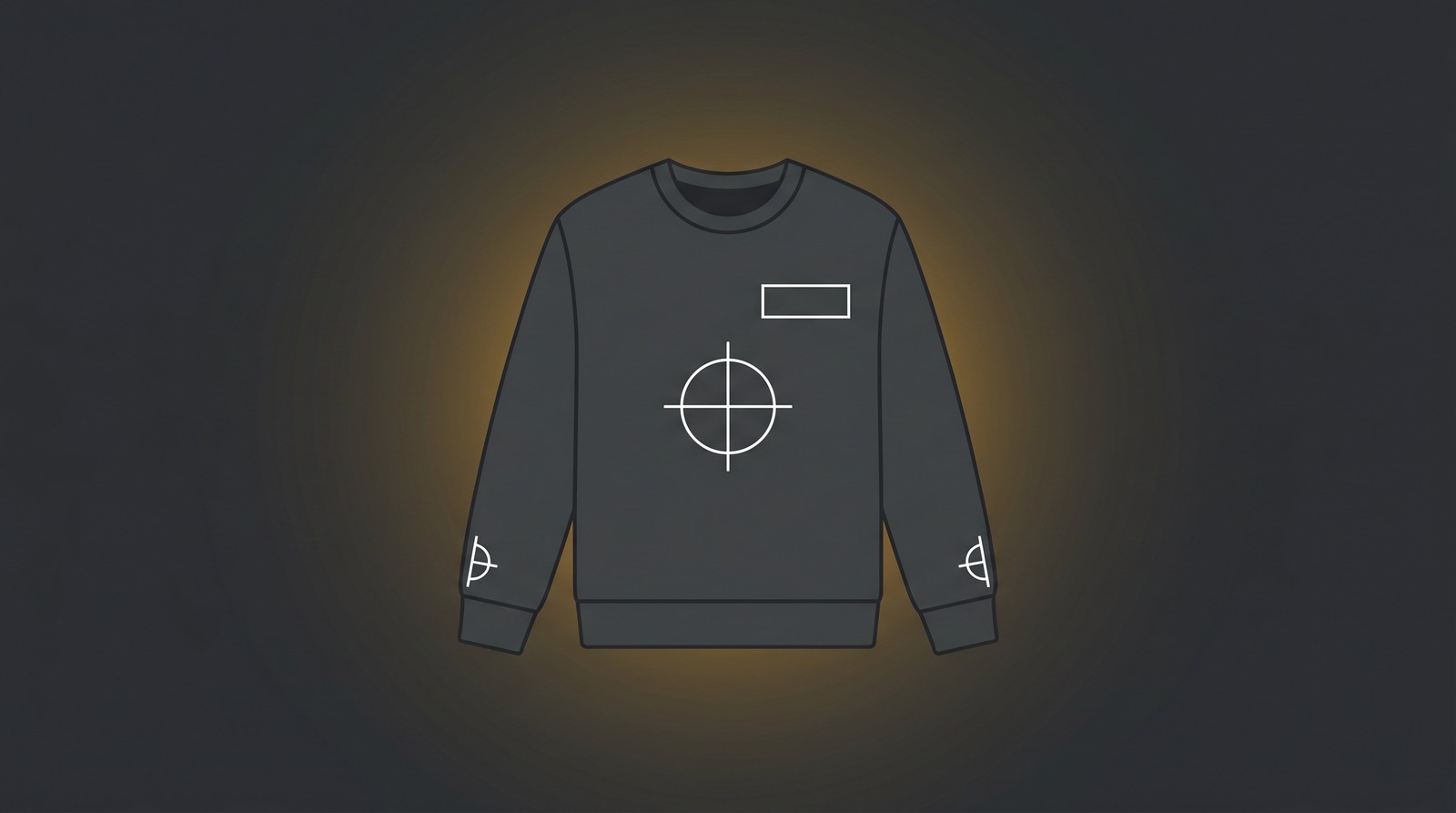
Print Placement Zones
The chest area (top third of the print zone) is your highest-impact real estate. This is what's visible when someone wears the sweatshirt with a jacket open, sits at a desk, or appears in photos from the waist up.
Design placement by style:
- Center chest: Classic, works for everything. 10" x 12" sweet spot.
- Left chest: Small logo or icon. 3.5" x 3.5" area. Premium, minimal feel.
- Full front: Statement pieces. Use the entire 15" x 18" zone.
- Oversized/pocket print: Trending hard in 2026. Place design lower, 8" x 8" area.
Color Considerations for Sweatshirt Printing
Sweatshirt design demands a different color strategy than t-shirts. Darker garments need white underbase printing (a layer of white ink printed first so colors pop against dark fabric). This affects your final output.
Designs with 4-6 bold colors outperform complex gradients on sweatshirts. The fleece texture softens subtle color transitions, so high-contrast designs look sharper.
What works best:
- Bold typography with 2-3 accent colors
- High-contrast graphic elements (white or bright colors on dark blanks)
- Vintage/distressed effects (the texture actually enhances this style)
- Simple icon-based designs with strong silhouettes
What to avoid:
- Photorealistic images (fleece texture kills fine detail)
- Designs with more than 8 colors (diminishing returns on print quality)
- Thin script fonts (they'll blur on textured fabric)
Want to do this yourself? Merch Titans automates the entire process.
Sweatshirt Design Ideas That Actually Sell
We've watched thousands of sweatshirt listings across Amazon, Etsy, and independent stores. These categories consistently generate sales, not just views.
1. College and University Aesthetic
The "collegiate look" sells year-round, not just to students. Arched text, vintage fonts, and school-spirit color palettes work even for fictional or humorous schools. Think "University of Napping" or "Department of Overthinking."
2. Location and Travel Designs
City names, state outlines, coordinates, and "Est." dates. These are gifting goldmines. Someone always needs a sweatshirt from their hometown, vacation spot, or alma mater's city.
3. Occupation and Hobby Pride
Nurses, teachers, engineers, dog moms, plant parents. Niche occupation and hobby sweatshirts convert at 2-4x the rate of generic motivational quotes because buyers feel personally connected to the design.
4. Matching Sets and Couples
Bride/groom, mom/dad, best friend pairs. These naturally double your average order value because customers buy two at once.
5. Seasonal and Holiday
Halloween, Christmas, Valentine's Day. Create designs 60-90 days before each holiday. Sweatshirt search volume explodes during Q4, and early listings accumulate reviews before peak demand.
Best Print on Demand Platforms for Custom Sweatshirts
Not every POD platform treats sweatshirts equally. Here's where to sell based on your business model.
MyDesigns - Best for Maximum Profit Control
MyDesigns gives you the highest margins in the POD space because you control pricing, branding, and customer relationships directly. For serious custom sweatshirt sellers, MyDesigns is the platform to build on.
At $39.99/month (or $29.99/month on annual billing), you get a full storefront that handles both physical POD products and digital products from one dashboard. That means you can sell a custom sweatshirt design AND the source design file as a digital download, maximizing revenue from every creation.
Why it wins for sweatshirts:
- Set your own margins (no platform-dictated royalty caps)
- Brand your store, packaging, and customer experience
- Sell physical + digital products together
- No per-listing fees eating into profits
Amazon Merch on Demand - Best for Volume
Amazon's built-in traffic is unmatched. Millions of buyers search for custom sweatshirts on Amazon daily, and Merch on Demand handles all production and fulfillment. The trade-off is lower per-unit margins and less brand control.
If you're scaling with Amazon Merch, bulk uploading tools are non-negotiable. Manual uploads cap your growth. For sellers still working through the tier system, our tier-up strategies guide covers how to accelerate that process.
Etsy + Printful/Printify - Best for Personalized Designs
Etsy buyers expect customization. Personalized name sweatshirts, custom date designs, and made-to-order pieces perform exceptionally well here. Connect a fulfillment partner like Printful or Printify to handle production. For a full breakdown, see our guide on the best print on demand for Etsy.
Scale Your Sweatshirt Business Faster
Automate research, uploads, and optimization across every platform from one dashboard.
Get Started Today →14-day money-back guarantee · Used by 150,000+ sellers since 2018
Print Methods Compared: DTG vs. Screen Print vs. Sublimation
The print method determines your design limitations, cost structure, and quality ceiling.
Direct-to-garment (DTG) is the default choice for print on demand sweatshirts because it requires zero setup cost and handles unlimited colors. Your design gets sprayed directly onto the fabric by an inkjet-style printer.
Screen printing makes sense only at volume. Below 50 units, the setup cost per screen ($25-$50 per color) kills your margins. Above 50 units, per-unit cost drops dramatically and screen print durability is unmatched.
Sublimation only works on polyester-heavy fabrics (65%+ polyester). It produces stunning all-over prints with vibrant colors that won't crack or peel. The limitation: it only works on white or very light-colored garments. For a deeper look at all-over print products, we've covered the full process separately.
| Method | Min Order | Colors | Best Fabric | Durability | Cost/Unit (1 pc) |
|---|---|---|---|---|---|
| DTG | 1 | Unlimited | Cotton/blend | Good | $15-$30 |
| Screen Print | 25-50 | 1-8 | Any | Excellent | $8-$15 |
| Sublimation | 1 | Unlimited | Polyester | Excellent | $18-$35 |
Sizing and Fit: Avoiding the #1 Return Reason
Incorrect sizing is the top reason customers return custom sweatshirts. This is entirely preventable with proper size charts and product descriptions.
Every sweatshirt listing needs:
- A detailed size chart with chest width, body length, and sleeve length in both inches and centimeters
- A fit description (true to size, oversized, slim fit)
- A recommendation ("If between sizes, order up for a relaxed fit")
- Fabric shrinkage notes (pre-shrunk cotton blends vs. 100% cotton that will shrink 5-8%)
The oversized fit trend is dominating 2026. Many buyers intentionally order 1-2 sizes up. Mention this in your listing copy. It reduces returns and increases customer satisfaction because you're anticipating their actual intent.
Standard Sweatshirt Size Guide (Unisex)
| Size | Chest Width | Body Length | Sleeve Length |
|---|---|---|---|
| S | 20" | 26" | 33.5" |
| M | 22" | 27" | 34.5" |
| L | 24" | 28" | 35.5" |
| XL | 26" | 29" | 36.5" |
| 2XL | 28" | 30" | 37.5" |
Include this (or your supplier's specific measurements) in every listing. Most POD platforms provide size chart templates you can customize.
The Contrarian Take: Stop Chasing Trends, Build a Sweatshirt Brand
Here's where most custom sweatshirt sellers get it wrong. They chase whatever design trend is hot on social media this week, pump out 50 variations, and wonder why nothing sticks.
The sellers making $5K-$10K/month from sweatshirts aren't trend chasers. They're brand builders. They pick a niche, a specific audience (dog owners, outdoor enthusiasts, nurses), and they create a cohesive collection that feels like a brand, not a random Etsy shop.
This is the old POD playbook dying in real time. Spray-and-pray worked in 2020 when competition was thin. In 2026, buyers have endless options. They buy from sellers who feel like brands.
What this looks like practically:
- Pick 2-3 design styles and stick with them (consistent aesthetic)
- Create "collections" of 5-10 related designs, not random one-offs
- Use consistent color palettes across your sweatshirt line
- Build an email list from day one (even a simple landing page works)
- Cross-sell between your t-shirt designs and sweatshirt versions
- Use AI design tools to speed up creation without sacrificing quality
The sellers who build a recognizable style get repeat buyers. Repeat buyers don't comparison shop. That's where real margin lives.
Selling Strategies That Move Custom Sweatshirts
Design is half the equation. The other half is getting your custom sweatshirts in front of buyers who are ready to purchase.
Keyword Optimization
Every platform runs on search. This is where most sellers either win or lose before a single customer sees their design. Your listing title, description, and tags need to match what buyers actually type. Use tools like the Etsy keyword research tool or Google keyword research tool to find real search data instead of guessing.
High-performing keyword patterns for sweatshirts:
- "[Niche] sweatshirt" (e.g., "dog mom sweatshirt")
- "Custom [occasion] sweatshirt" (e.g., "custom bachelorette sweatshirt")
- "[Location] crewneck" (e.g., "Nashville crewneck")
- "Funny [occupation] sweatshirt" (e.g., "funny teacher sweatshirt")
Seasonal Launch Calendar
Plan your design launches around search volume patterns. Based on keyword data, here's when to have sweatshirt designs live and indexed:
- August: Back-to-school, fall preview
- September: Halloween designs go live
- October: Christmas/holiday gift designs uploaded
- November: Peak selling month, no new uploads needed, focus on ads
- January: Valentine's Day and spring designs
- March: Graduation season prep
Pricing Strategy
Price your custom sweatshirts based on perceived value, not cost-plus. Most POD sellers underprice because they anchor to the base cost. Your buyer doesn't know (or care) what the blank costs. We've seen sellers increase revenue 40% overnight just by raising sweatshirt prices from $29 to $38, with no drop in conversion rate.
For Amazon sellers specifically, check out our Amazon Merch pricing strategy guide for platform-specific tactics.
Price crewneck sweatshirts between $34-$42 and hoodies between $39-$55. These ranges match buyer expectations for custom, made-to-order products while leaving healthy margins.
Before setting your final prices, always run a trademark check using the Merch Titans trademark checker to make sure your designs and brand names are clear.
Merch Titans Automation
Ready to Launch Your Custom Sweatshirt Line?
Merch Titans gives you the research tools, automation, and speed to go from design to live listings in minutes.
14-day money-back guarantee · No contracts · Cancel anytime
Your sweatshirt designs are worth more than t-shirt royalties. The sellers who figure that out first build the biggest POD businesses.
The tools exist. The demand data is clear. The platforms are ready. The only question left is whether you're designing for real margins or still stuck uploading the cheapest product type and hoping for volume to save you.
Frequently Asked Questions
How much does it cost to make a custom sweatshirt?
A custom sweatshirt through print on demand costs between $15-$30 per unit at base price, with no upfront inventory investment. Your retail price typically ranges from $35-$55, leaving a profit margin of $10-$25 per sale depending on the platform and print method.
What is the best print method for custom sweatshirts?
Direct-to-garment (DTG) printing is the best method for custom sweatshirts sold through print on demand because it handles complex, multi-color designs on cotton-blend fabrics with no minimum order quantity. For bulk orders, screen printing offers lower per-unit costs at 50+ pieces.
What size should my sweatshirt design file be?
Your sweatshirt design file should be at least 4500 x 5400 pixels at 300 DPI for a standard front print area of 15 x 18 inches. Always use PNG format with transparent backgrounds for the cleanest print output.
Can you make money selling custom sweatshirts online?
Selling custom sweatshirts online is one of the most profitable print on demand niches, with average profit margins of 30-45% per unit. Sweatshirts have higher perceived value than t-shirts, which means customers accept higher retail prices and you keep more profit per sale.
What are the best platforms to sell custom sweatshirts?
The best platforms to sell custom sweatshirts are MyDesigns for maximum profit margins and full control, Amazon Merch on Demand for massive organic traffic, and Etsy for niche and personalized designs. Each platform serves a different selling strategy.
What fabric is best for print on demand sweatshirts?
A 50/50 cotton-polyester blend is the best fabric for print on demand sweatshirts because it accepts DTG ink well, resists shrinking, and holds color vibrancy through repeated washes. 100% cotton sweatshirts offer a softer feel but are more prone to shrinkage.