Most print on demand sellers choose suppliers backward. They pick the cheapest option or the first platform they discover, then wonder why reviews mention "poor quality" or "took forever to arrive."
The result: 23-41% lost revenue through returns, negative reviews, and zero repeat customers. The fix: A systematic evaluation framework that weighs quality, cost, speed, and reliability before you invest design time.
This guide provides that framework.
What Makes a Good Print on Demand Supplier?
Great suppliers deliver three non-negotiables: Consistent quality, reliable fulfillment, and transparent pricing. Everything else is optimization.
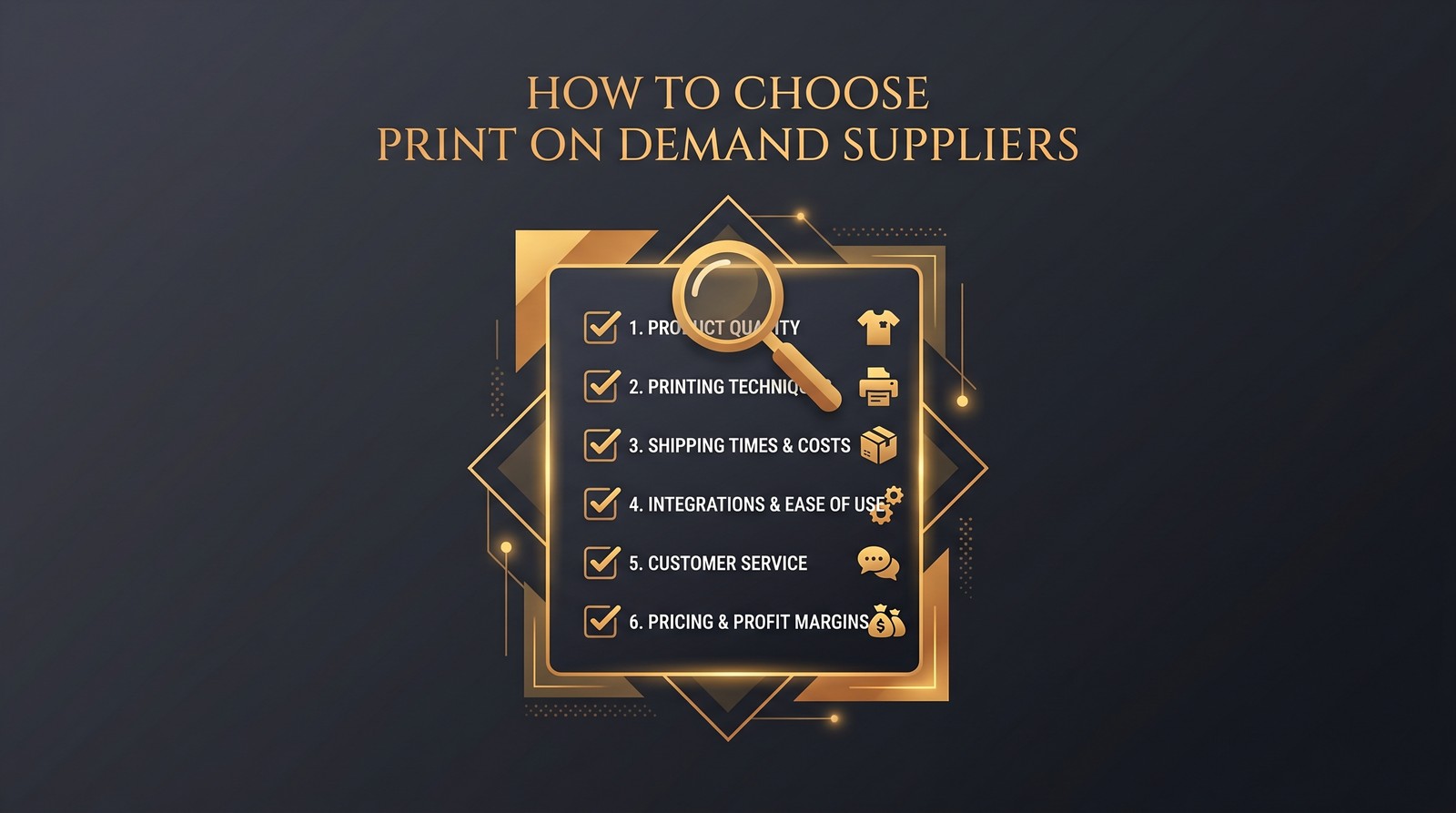
The 7-Factor POD Supplier Evaluation Framework
Factor 1: Production Quality (Most Important)
Quality determines repeat purchase rates, review ratings, and brand perception. No amount of marketing fixes a blurry print or cracked design.
How to evaluate:
- Order 3-5 sample products from each supplier
- Test print sharpness, color accuracy, and placement
- Wash samples 3-5 times (check for cracking, fading, shrinkage)
- Compare fabric/material quality across suppliers
- Inspect packaging and presentation
What to look for:
- Vibrant, accurate colors (no color shift from preview)
- Sharp text and fine details (no pixelation or blur)
- Proper design placement (centered, straight, sized correctly)
- Durable prints (no cracking after 3-5 washes)
- Quality materials (soft fabric, smooth finishes)
Red flags:
- Colors 20%+ different from preview
- Blurry text or jagged edges on graphics
- Off-center or crooked placement
- Cracking after 1-2 washes
- Thin, cheap-feeling materials
Factor 2: Pricing and Profit Margins
Base cost isn't profit. Calculate total cost including shipping, platform fees, payment processing, and marketing to determine real margins.
Pricing breakdown for t-shirts (example):
| Supplier | Base Cost | Shipping | Total | Sell Price | Margin |
|---|---|---|---|---|---|
| Printify Budget | $8.50 | $4.99 | $13.49 | $24.99 | $11.50 (46%) |
| Printful Standard | $11.95 | $4.99 | $16.94 | $27.99 | $11.05 (39%) |
| Amazon Merch | $13.49 (cost) | Included | $13.49 | $25.99 | $12.50 (48%) |
How to evaluate:
- Compare base costs for your top 5 product types
- Add shipping costs (domestic + international)
- Factor platform fees (Etsy 6.5%, Shopify 2.9%+30¢)
- Calculate net profit per sale
- Model at 10, 100, and 1000 sales/month
What to look for:
- 40%+ profit margins after all costs
- Transparent pricing (no hidden fees)
- Volume discounts at scale (1000+ orders/month)
- Competitive shipping rates
Red flags:
- Margins under 35% (unsustainable after ads)
- Hidden fees discovered at checkout
- Shipping costs 2× higher than competitors
- No volume discounts despite high order counts
Want to do this yourself? Merch Titans automates the entire process.
Factor 3: Shipping Speed and Reliability
Shipping speed determines review ratings and repeat purchase rates. Fast, reliable shipping generates positive reviews. Slow, unpredictable shipping generates complaints.
How to evaluate:
- Order samples and track actual fulfillment time
- Test production time (order → ships): 1-3 days ideal, 5-7 days acceptable
- Test shipping time (ships → delivered): 3-5 days ideal domestic
- Check supplier fulfillment center locations
- Read reviews for shipping complaints
What to look for:
- 1-3 day production time consistently
- 3-5 day domestic shipping (US/EU)
- Multiple fulfillment centers (distributed network)
- Predictable delivery windows
- Tracking provided automatically
Red flags:
- Production delays 5-7+ days regularly
- Shipping estimates "7-14 days" (too variable)
- Single fulfillment center (international delays)
- No tracking numbers
- Reviews mentioning "took forever" or "never arrived"
Read our complete shipping times comparison
Factor 4: Product Variety and Quality Range
Product variety enables niche expansion and upsells. Start with t-shirts, scale to hoodies, mugs, phone cases, and niche-specific products.
How to evaluate:
- List your top 10 desired products
- Check if supplier offers all products
- Verify product quality across categories (not just t-shirts)
- Test less common products (tote bags, stickers, wall art)
- Check new product addition frequency
What to look for:
- 50+ products minimum (100+ ideal)
- Core apparel (t-shirts, hoodies, sweatshirts, tank tops)
- Accessories (hats, bags, phone cases, stickers)
- Home goods (mugs, pillows, blankets, wall art)
- Regular new product launches
Red flags:
- Limited to 10-20 products (growth ceiling)
- Poor quality on non-apparel items
- No product additions in 12+ months
- Missing core product categories
Factor 5: Platform Integrations and Automation
Manual uploads kill momentum. Suppliers that integrate with Shopify, Etsy, WooCommerce, and automation tools save hundreds of hours.
How to evaluate:
- Check native integrations (Shopify, Etsy, WooCommerce, Amazon)
- Test API access for automation
- Verify bulk upload capabilities
- Check Merch Titans compatibility for multi-platform automation
- Review integration quality (automatic order syncing, tracking updates)
What to look for:
- Native integrations with your sales platforms
- API access for automation tools
- Bulk product creation (50-100+ at once)
- Automatic order fulfillment (no manual processing)
- Real-time inventory and tracking syncing
Red flags:
- Manual order processing required
- No API or automation options
- Integration bugs or sync failures
- Limited to one sales platform
Factor 6: Customer Service and Support Quality
Problems happen. Support quality determines how fast you resolve them. Good support responds within 24 hours. Great support resolves issues within 48 hours.
How to evaluate:
- Submit a pre-sales question (test response time)
- Order samples and deliberately ask a support question
- Read reviews mentioning customer service
- Check available support channels (email, chat, phone)
- Test refund/replacement process
What to look for:
- Response within 24 hours (email)
- Live chat available during business hours
- Clear refund/replacement policies
- Proactive communication on delays
- Helpful, solution-focused responses
Red flags:
- No response after 48-72 hours
- Canned, unhelpful responses
- No phone or chat support
- Refund requests denied without reason
- Defensive or dismissive tone
Factor 7: Business Reliability and Longevity
Platform risk is real. Suppliers can shut down, change terms, or get acquired. Choose established, financially stable companies.
How to evaluate:
- Check company founding date (3+ years minimum, 5+ ideal)
- Search "[supplier name] shutdown" or "going out of business"
- Read seller forums for platform issues
- Check financial backing (venture funding signals stability)
- Monitor social media activity (dormant accounts = warning sign)
What to look for:
- 5+ years in business
- Active development (new features, products)
- Transparent ownership and leadership
- Positive seller community sentiment
- Regular communication from company
Red flags:
- Founded less than 2 years ago (unproven)
- No recent product or feature updates
- Mass seller complaints or exodus
- Dormant social media (6+ months no posts)
- Vague ownership or contact information
Merch Titans Automation
Automate POD Uploads Across All Suppliers
Use multiple suppliers without multiplying workload. Merch Titans handles multi-platform uploads in 30 seconds. $39.99/mo or $29.99/mo annual.
14-day money-back guarantee · No contracts · Cancel anytime
How to Compare POD Suppliers: Decision Matrix
Use this matrix to score suppliers systematically:
| Criteria | Weight | Supplier A | Supplier B | Supplier C |
|---|---|---|---|---|
| Quality | 30% | 8/10 | 9/10 | 7/10 |
| Pricing | 20% | 7/10 | 6/10 | 9/10 |
| Shipping | 20% | 9/10 | 7/10 | 6/10 |
| Products | 10% | 8/10 | 9/10 | 6/10 |
| Integration | 10% | 7/10 | 8/10 | 9/10 |
| Support | 5% | 6/10 | 8/10 | 7/10 |
| Reliability | 5% | 9/10 | 9/10 | 7/10 |
| Total | 100% | 7.8 | 8.0 | 7.4 |
How to use:
- List 3-5 suppliers you're considering
- Order samples and test each supplier
- Score each factor 1-10 based on your evaluation
- Multiply score by weight percentage
- Choose top 2-3 suppliers for different use cases
Recommended Multi-Supplier Strategy
Don't rely on one supplier. Use 2-4 strategically:
Primary Supplier (70-80% of orders)
Purpose: Core products, volume orders, proven quality and speed
Best options: Printify (budget), Printful (premium), Amazon Merch (US traffic)
Backup Supplier (10-20% of orders)
Purpose: Redundancy if primary has issues, product variety gaps
Best options: Different provider than primary, similar quality/pricing tier
Premium Supplier (5-10% of orders)
Purpose: High-quality custom orders, branded packaging, special products
Best options: Printful, Gelato, SPOD (EU)
International Supplier (if targeting global)
Purpose: Fast international shipping, local fulfillment
Best options: Gelato (32 countries), SPOD (EU), Printful (global)

Top POD Suppliers Compared (2026)
MyDesigns — Best for Maximum Margins + Digital Products
Pros: Highest profit margins (sell physical + digital products), full control, integrated design tools
Cons: Newer platform, requires more setup than marketplaces
Best for: Sellers prioritizing margins, hybrid physical + digital strategy
Amazon Merch — Best for Organic Traffic
Pros: 2-3 day Prime shipping, built-in Amazon traffic, passive fulfillment
Cons: Account approval required, strict content policies, slow international
Best for: US-focused sellers prioritizing discovery and fast shipping
Printful — Best for Premium Quality + Branding
Pros: Premium quality, custom branding options, 300+ products, warehousing
Cons: Higher prices ($11-13 t-shirts), international shipping costs
Best for: Shopify sellers prioritizing quality and brand presentation
Printify — Best for Budget + Flexibility
Pros: Competitive pricing ($8-10 t-shirts), 90+ print providers, broad product catalog
Cons: Quality varies by provider, less hand-holding than Printful
Best for: Budget-conscious sellers willing to test providers
Gelato — Best for International Fulfillment
Pros: 32-country network, local printing, fast international shipping (2-5 days)
Cons: Higher prices, smaller product catalog than Printify/Printful
Best for: International sellers, global customer base
SPOD — Best for European Sellers
Pros: Fast EU fulfillment (2-5 days), competitive pricing, quality focus
Cons: Limited US presence, smaller product catalog
Best for: EU-based sellers, European customer focus
Redbubble — Best for 100% Passive Income
Pros: Zero setup, automatic fulfillment, built-in marketplace traffic
Cons: Lowest margins (15-25%), slow shipping (10-14 days), no control
Best for: Passive income seekers, hands-off operation
Compare all platforms in detail
Common POD Supplier Selection Mistakes
Mistake 1: Choosing Based on Price Alone
Why it fails: Cheapest supplier often has worst quality, slowest shipping, or poorest service. Result: Returns, complaints, negative reviews cost more than higher base costs.
Fix: Calculate total profit after quality issues, returns, and customer lifetime value. Premium supplier at $12/shirt beats budget supplier at $8/shirt if quality drives repeat purchases.
Mistake 2: Not Ordering Samples Before Launching
Why it fails: 60% of sellers regret first supplier choice after customers complain about quality they never tested.
Fix: Order 3-5 samples from every supplier. Test wash durability. Compare side-by-side. Only launch with suppliers whose quality you'd buy yourself.
Mistake 3: Using Only One Supplier (Platform Risk)
Why it fails: One platform change, ban, or shutdown = zero income overnight.
Fix: Use 2-4 suppliers strategically. Diversify platform risk while optimizing for different use cases (speed, cost, quality, international).
Mistake 4: Ignoring Shipping Speed Until Complaints Arrive
Why it fails: Slow shipping tanks review ratings and repeat purchase rates before you realize it's a problem.
Fix: Order samples and track actual fulfillment time. Choose suppliers with 3-5 day domestic shipping. Communicate accurate delivery estimates at checkout.
Mistake 5: Choosing Suppliers With No Automation Options
Why it fails: Manual processes cap growth at 50-100 live designs. Automation enables 1000+ designs and 10× revenue.
Fix: Prioritize suppliers with API access and automation tool compatibility. Merch Titans automates uploads across platforms.

Common Questions About Choosing POD Suppliers
How long does it take to switch POD suppliers?
Switching takes 1-2 weeks of testing and setup. Order samples (3-5 days), evaluate quality (2-3 days), set up integrations (1-2 days), migrate top products first (2-3 days), then expand. Keep old supplier active initially to ensure smooth transition.
Can I use multiple POD suppliers on the same platform?
Yes. Most platforms support multiple fulfillment partners. Shopify, Etsy, and WooCommerce let you assign different suppliers to different products. Use for optimization: fastest supplier for bestsellers, budget supplier for low-margin products, premium supplier for high-ticket items.
How do I handle customers asking about supplier/fulfillment?
Be transparent but strategic. "We work with premium fulfillment partners in the US [or your region] to ensure quality and fast shipping" satisfies most customers. Avoid naming specific suppliers unless asked directly. Focus messaging on quality, speed, and your brand rather than third-party partners.
Should I negotiate better rates with POD suppliers?
Yes, once you hit 500-1000 orders/month. Contact supplier account managers with your monthly volume and request volume discounts. Most suppliers offer 5-15% discounts for high-volume sellers. Bring competing supplier pricing for leverage.
What if my chosen supplier quality drops after launch?
Act immediately. Order monthly sample checks to catch quality degradation early. If quality drops, contact supplier with photographic evidence and request corrective action. If unresolved within 30 days, migrate products to backup supplier. Don't let declining quality destroy your brand.
How do I test new POD suppliers without disrupting sales?
Parallel test: Add new supplier as secondary option. Create duplicate listings with new supplier. Run small paid traffic test (100 orders). Compare quality, shipping, and complaints. Migrate bestsellers only if new supplier outperforms. Keep old supplier for other products.
Choose POD Suppliers Strategically, Not Randomly
Supplier selection determines profit margins, customer satisfaction, and business sustainability. Most POD sellers choose based on convenience or price, then pay for it in returns, complaints, and stalled growth.
Successful sellers use a systematic evaluation framework: Order samples from 3-5 suppliers. Test quality, pricing, speed, and service. Choose 2-4 suppliers strategically (primary, backup, premium, international). Automate multi-supplier uploads with tools like Merch Titans.
Stop choosing suppliers based on who has the prettiest website or lowest base cost. Start choosing based on total profit, quality standards, and strategic fit.
Sample first. Evaluate systematically. Choose strategically. Scale confidently.
Frequently Asked Questions
What should I look for when choosing a print on demand supplier?
Prioritize production quality (order samples first), base costs and profit margins, shipping speed and reliability, product variety aligned with your niche, integration options with your sales channels, customer service responsiveness, and transparent pricing. Test with small orders before committing to high-volume production.
How many POD suppliers should I use?
Use 2-4 POD suppliers strategically: one primary supplier for core products and volume orders, one backup supplier for redundancy, one premium supplier for high-quality/custom orders, and one international supplier for global customers. Multiple suppliers reduce platform risk and optimize for different use cases.
What is the best print on demand supplier for beginners?
Printify is the best POD supplier for beginners due to competitive pricing, 90+ print provider options for testing, low minimum orders, easy platform integrations, and beginner-friendly interface. Alternatively, Amazon Merch offers the simplest setup with built-in traffic but requires account approval.
How do I test print on demand supplier quality before launching?
Order 3-5 sample products from each supplier you consider. Test print quality, color accuracy, fabric feel, packaging presentation, and shipping speed. Wash samples 3-5 times to test durability. Compare samples side-by-side under natural light. Only launch with suppliers whose quality meets your standards.
Should I use the cheapest print on demand supplier?
No. The cheapest supplier rarely offers the best value. Low base costs often hide quality issues, slow production, poor customer service, or limited product options. Calculate total cost including shipping, returns, and customer lifetime value. A supplier 20% more expensive with 50% fewer quality complaints generates higher profit long-term.
Can I switch print on demand suppliers after launching?
Yes. Most POD businesses switch or add suppliers as they scale. Test new suppliers with sample orders, migrate top-selling products first, maintain old supplier for legacy products initially, and clearly communicate any changes to customers if quality or shipping times change. Switching takes 1-2 weeks of testing and setup.