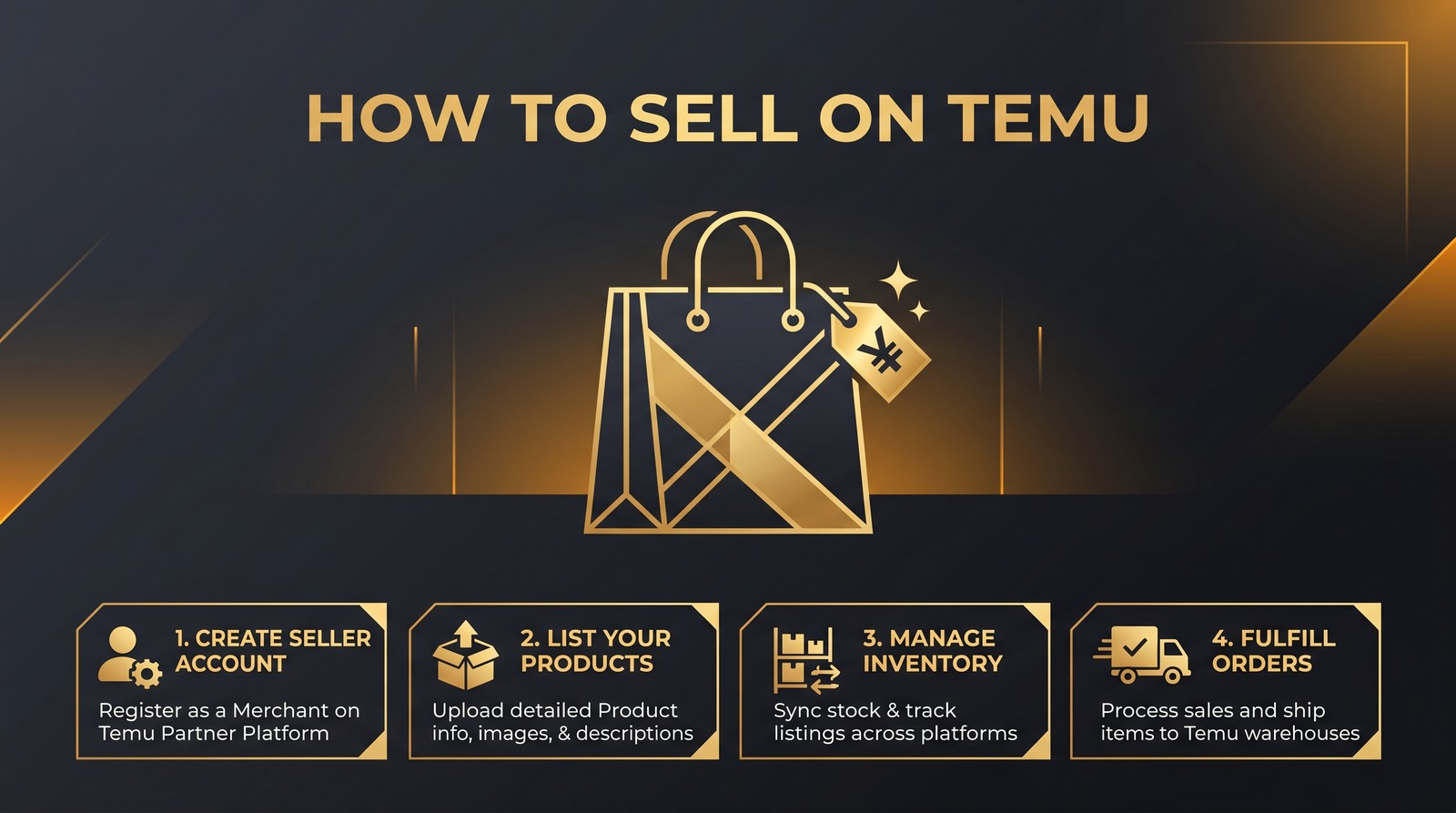
Temu hit $8 billion in monthly revenue in early 2026. That number gets sellers excited. What they don't hear is that most of that revenue flows to manufacturers selling at near-cost prices, leaving third-party sellers fighting over scraps.
Here's the reality: selling on Temu can work, but only if you understand exactly what you're signing up for. This isn't Amazon. This isn't Etsy. Temu is a price-war marketplace where the lowest price almost always wins. If that math works for your business, this guide walks you through every step. If it doesn't, we'll show you where to sell instead.
What Is Temu?
Temu launched in the US in September 2022 and grew explosively through aggressive social media marketing and a gamified shopping experience. Flash deals, spin-the-wheel discounts, and "team up, price down" group buying turned casual browsers into impulse buyers.
Originally, Temu only worked with Chinese manufacturers shipping directly to consumers. That changed in March 2024 when US-based sellers gained access to domestic fulfillment options. By November 2024, any US merchant could sell on the Temu marketplace with self-fulfillment or partner logistics.
The platform now spans dozens of countries and hundreds of product categories. But the DNA hasn't changed. Temu's core value proposition to shoppers is extreme affordability, which means sellers operate on thin margins by design.
How to Become a Temu Seller: Step-by-Step
Getting set up on Temu isn't complicated, but the approval process is stricter than platforms like Etsy or eBay. Here's the exact process:
1. Create Your Seller Account
Head to the Temu Seller Center and register with your business email. You'll choose between selling as a business entity or individual seller (business accounts get faster approval and more features).
2. Submit Required Documents
This is where most new sellers hit friction. Temu requires:
- Business verification - Business license, tax ID, or equivalent proof of legitimacy
- Bank account details - Must match your registered business name exactly
- Contact information - Name, phone number, email, and customer service contact
- Product samples or details - Depending on your category, Temu may request previews of what you plan to sell
Missing or mismatched documents are the #1 reason for delayed approvals. Double-check that your bank account name matches your business registration before submitting.
3. Set Up Your Seller Profile
Once approved (typically 2-5 business days), configure your storefront in the Temu app. Add your store name, profile photo, and business description. This is what shoppers see when they visit your seller page.
Keep it clean and professional. Temu shoppers are skeptical by default since the platform's reputation for ultra-cheap goods means they're watching for quality signals.
4. Add Product Listings
Tap "Add Products" and start building your catalog:
- Product title - Front-load with search terms Temu shoppers actually use
- Description - Clear, benefit-driven copy with specifications
- Images - High-quality photos from multiple angles on clean backgrounds
- Pricing - Research competing listings and price competitively (more on this below)
- SKU and specifications - Size, color, material, weight for accurate shipping calculations
Every listing goes through Temu's review process before going live. Expect 24-48 hours for most approvals.
5. Configure Fulfillment and Shipping
This is where the Temu seller experience diverges from other marketplaces. You have two options:
Self-fulfillment: You store, pack, and ship orders directly. Temu requires shipment within 48 hours using approved carriers, with tracking numbers on every order. You handle returns too.
Temu partner fulfillment: Ship bulk inventory to Temu's US-based warehouse partners. They handle picking, packing, and shipping. Storage fees apply, but you offload the logistics headache.
Temu Seller Fees: The Full Breakdown
Here's where Temu gets interesting. The platform currently charges zero subscription fees, zero listing fees, and zero payment processing fees for US sellers.
That sounds too good to be true, and there's a catch. While Temu doesn't charge traditional marketplace fees, sellers absorb costs in other ways:
| Fee Type | Cost |
|---|---|
| Monthly subscription | $0 |
| Listing fees | $0 |
| Payment processing | $0 |
| Shipping (standard) | Seller-paid (varies by size/weight) |
| Partner fulfillment | Variable storage + handling fees |
| Returns processing | Seller-paid |
The real "fee" on Temu is the pricing pressure. Shoppers expect rock-bottom prices. If your competitor lists the same product for $2 less, they win. This race to the bottom is Temu's biggest hidden cost.

What Sells Best on the Temu Marketplace
Not every product category makes sense on Temu. The platform's bargain-hunting audience gravitates toward specific types of products:
High performers on Temu:
- Phone accessories and tech gadgets
- Home organization and kitchen tools
- Fashion accessories (jewelry, bags, scarves)
- Beauty and personal care products
- Seasonal and impulse-buy items
Poor fit for Temu:
- Premium or luxury goods (shoppers expect low prices)
- Complex products requiring customer support
- Heavy items with expensive shipping
- Custom or personalized products
- Print on demand products (no native POD support)
The sweet spot is lightweight, low-cost products with broad appeal and impulse-buy potential. If your product requires education or has a premium positioning, Temu isn't your marketplace.
Want to do this yourself? Merch Titans automates the entire process.
Temu Print on Demand: The Hard Truth
We get asked about Temu print on demand constantly. Here's the straight answer: Temu has no native print on demand integration. You cannot connect a POD supplier like Printful or Printify and fulfill on-demand through Temu.
To sell custom-designed products on Temu, you'd need to:
- Pre-produce inventory with a POD supplier
- Ship bulk stock to your warehouse or Temu's fulfillment partners
- Fulfill orders from that pre-made inventory
That defeats the entire point of print on demand. You're taking on inventory risk, upfront costs, and storage fees, which is everything POD is designed to eliminate.
Where POD Sellers Should Actually Sell
If you're in the print on demand space, your platform choice matters more than almost any other business decision. You need a marketplace that supports on-demand fulfillment, gives you brand control, and doesn't crush your margins.
MyDesigns is purpose-built for this. It lets you sell both physical POD products and digital products from one platform, with the highest margins in the industry. You control your brand, your pricing, and your customer relationships. No race to the bottom.
For POD sellers already using Amazon Merch on Demand, pairing it with MyDesigns gives you the best of both worlds: Amazon's traffic plus MyDesigns' margin and control advantages.
Optimizing Your Temu Listings for Maximum Sales
If Temu makes sense for your product line, execution matters. Here's how to stand out on a platform where everyone's competing on price:
Nail Your Product Photography
Temu shoppers scroll fast. Your main image has about 1 second to stop the thumb.
- Use a clean white background for the primary image
- Show the product from 4-5 angles minimum
- Include a scale reference (product next to a hand or common object)
- Add a lifestyle shot showing the product in use
Optimize Titles and Descriptions
Temu's search algorithm weights product titles heavily. Front-load your title with the terms shoppers actually search for, not marketing fluff.
Bad: "Amazing Premium Quality Kitchen Gadget - Best Seller" Good: "Vegetable Spiralizer Handheld Zucchini Noodle Maker - Stainless Steel"
Use Temu's search bar autocomplete to discover what buyers type. Build those terms into your titles and descriptions naturally. For deeper keyword research, tools designed for marketplace optimization give you volume data and competition metrics.
Price Strategically
The lowest price doesn't always win on Temu, but being within 10-15% of the lowest competitor usually does.
- Research the top 5 listings for your product category
- Calculate your all-in cost (product + shipping + returns buffer)
- Set your price at 10-15% above your floor with room for Temu's promotional discounts
- Use strikethrough pricing to show "original" vs. "sale" price, which is huge on Temu

Temu vs. Other Marketplaces: Where Should You Actually Sell?
Temu isn't the only option. Where you sell should match your business model, margins, and growth goals.
The contrarian take most sellers won't hear: Temu's zero-fee structure is a customer acquisition play, not a permanent business model. Marketplaces always increase fees once sellers are locked in. Amazon started with lower fees too. Building your business on a platform where you have zero brand equity and zero pricing power is a risk, not a strategy.
Build Your POD Empire the Right Way
Merch Titans gives you the automation tools to scale across platforms that actually pay you what you're worth.
Get Started Today →14-day money-back guarantee · Used by 150,000+ sellers since 2018
Temu Seller Performance Metrics You Need to Track
Temu monitors seller performance aggressively. Fall below their benchmarks and your visibility tanks, or worse, your account gets suspended.
Key metrics Temu tracks:
- Order fulfillment rate - Must ship within 48 hours consistently. Anything below 95% triggers warnings.
- Tracking upload rate - Every order needs a valid tracking number. No exceptions.
- Customer response time - Respond to buyer messages within 24 hours or your rating drops.
- Return and refund rate - Keep below 5% or Temu flags your account for review.
- Product quality score - Based on customer reviews, return reasons, and complaint patterns.
The performance system is unforgiving. Unlike Amazon where you can recover from occasional dips, Temu's algorithm reacts fast. A bad week of late shipments can bury your listings for months.
This is another reason to have your fulfillment locked down before listing your first product. Whether you're self-fulfilling or using Temu's partners, test the process with small batches before scaling.
Common Mistakes New Temu Sellers Make
We've watched sellers make the same mistakes on Temu over and over. Save yourself the pain:
Ignoring shipping costs in pricing. Temu mandates free shipping for buyers. If you price your product at $5 and shipping costs $3, your actual margin is based on $2 minus product cost. Many sellers realize this after their first month of "profitable" sales.
Treating Temu like Amazon. Amazon shoppers pay premiums for convenience and trust. Temu shoppers want the cheapest possible price. Your Amazon listing strategy won't translate.
Over-investing in a single channel. Temu could change its fee structure, algorithm, or seller requirements overnight. Sellers who built exclusively on Temu have no leverage if the platform pivots. Diversify across platforms from day one.
Skipping product research. Listing random products hoping something sticks wastes time and money. Use the platform's bestseller lists, trending product research, and competitive analysis before investing in inventory.
Neglecting customer service. Temu monitors seller performance metrics closely. Slow responses, late shipments, and unresolved complaints tank your visibility. Treat every review like it's a billboard.
Building a Multi-Platform Selling Strategy
The smartest approach to Temu isn't all-in. It's strategic.
Use Temu for what it's good at: moving high-volume products to price-sensitive buyers. Then build your actual brand and margins elsewhere.
A proven multi-platform stack for 2026:
- MyDesigns for POD and digital products with maximum margins
- Amazon for scale and FBA convenience (pair with Merch Titans automation to save hours)
- Temu for volume on commodity products
- Your own store for full brand control and customer ownership
This approach hedges against any single platform's policy changes while maximizing revenue across different buyer segments. Tools like our keyword research suite help you optimize listings across every platform simultaneously.
The sellers hitting six figures aren't loyal to one marketplace. They're building systems that work across all of them.
Is Temu Right for Your Business?
Let's cut through the hype. Temu works for a specific type of seller with a specific type of product.
Temu is right for you if:
- You source products at rock-bottom costs with room for 15-20% margins after shipping
- You can handle high volume with consistent fulfillment quality
- You're selling commodity products where brand doesn't matter
- You want to diversify revenue across marketplaces
Temu is wrong for you if:
- You sell custom, personalized, or print on demand products
- Your margins require premium pricing
- You want to build a recognizable brand with repeat customers
- You don't have fulfillment infrastructure for 48-hour shipping
If you're in the POD space, stop trying to make Temu work. Build on MyDesigns where the platform is designed for your business model, then use Merch Titans tools to automate the grunt work across every channel that actually pays you.
Merch Titans Automation
Scale Across Every Platform That Matters
Merch Titans automation tools help you list, optimize, and manage products across Amazon, Etsy, and beyond. Stop doing it manually.
14-day money-back guarantee · No contracts · Cancel anytime
Frequently Asked Questions
How much does it cost to sell on Temu?
Temu currently charges zero subscription fees, zero listing fees, and zero payment processing fees for US sellers. The main costs are product sourcing, shipping (sellers cover standard shipping), and optional fulfillment fees if using Temu's partner warehouses.
Can you do print on demand on Temu?
Temu does not natively support print on demand fulfillment. Sellers need physical inventory or a third-party logistics provider. For POD sellers, platforms like MyDesigns offer built-in print on demand with higher margins and full brand control.
How long does it take to get approved as a Temu seller?
Temu seller approval typically takes 2 to 5 business days after submitting all required documents. Some sellers report faster approval within 24 hours, while complex applications with missing documentation can take longer.
Is selling on Temu profitable?
Selling on Temu can be profitable for high-volume, low-cost products where margins survive aggressive pricing pressure. Most sellers report 10-20% margins at best. Sellers wanting higher profits should consider platforms like MyDesigns where they control pricing and keep larger margins.
What are the requirements to sell on Temu?
Temu requires a valid business license or tax ID, bank account information matching your business name, contact details, and product samples or listings for review. Individual sellers may qualify in some regions, but businesses get faster approval.