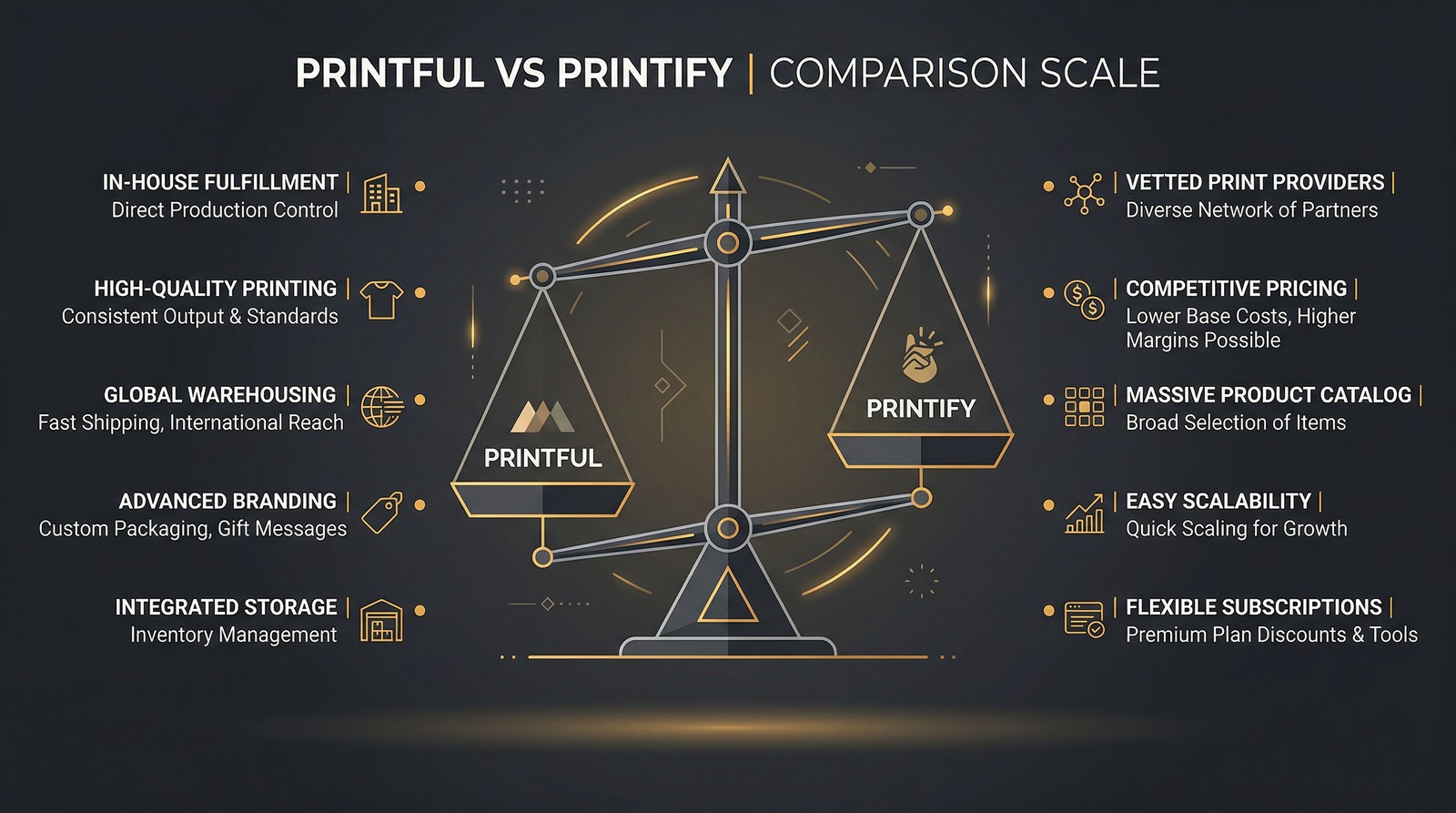
Here is the honest truth about Printful vs Printify that most comparison articles won't tell you: the "better" platform depends entirely on what you're building. A side hustler selling ten designs needs a completely different setup than someone pushing 500 SKUs across four marketplaces.
We have watched thousands of sellers agonize over this decision when the real bottleneck in their business was never the fulfillment platform. It was the workflow around it.
That said, there are real, measurable differences between Printful and Printify that matter. Let's break them down without the affiliate-driven bias you'll find everywhere else.
The Business Model Difference That Changes Everything
Printful and Printify look similar on the surface, but they operate on fundamentally different models.
Printful manufactures most products in-house. They own the factories, employ the workers, and control production from start to finish. This means more consistency but higher base costs.
Printify is a marketplace of print providers. They connect you with dozens of manufacturers worldwide, each with their own pricing, quality standards, and shipping times. This means lower costs but more variability.
This single difference cascades into every other comparison point. Quality, pricing, shipping speed, branding options - all of it traces back to this architectural decision.
Pricing Breakdown: Where Your Margins Actually Land
Let's talk real numbers. On a standard Gildan 64000 unisex t-shirt (the most commonly sold POD product):
| Factor | Printful | Printify |
|---|---|---|
| Base cost (single shirt) | ~$12.95 | ~$6.21 |
| Monthly plan | Free or $24.99 (Growth) | Free or $24.99 (Premium) |
| Plan discount | Up to 30% off products | Up to 20% off products |
| With plan discount | ~$9.07 | ~$4.97 |
| Typical retail price | $24.99 | $24.99 |
| Your profit | $15.92 | $20.02 |
That's a $4+ difference per shirt. At 100 sales per month, Printify puts roughly $400 more in your pocket.
But margins alone don't tell the full story. Printful's higher cost comes with fewer quality complaints, fewer refund requests, and more consistent branding. If you're losing 5-10% of orders to quality issues with a low-cost Printify provider, those savings evaporate.
The Hidden Cost Nobody Talks About
Both platforms eat time. Creating listings, optimizing mockups, managing inventory across multiple platforms - that's where most sellers bleed hours.
A seller running 200 designs across Etsy, Shopify, and Amazon is spending 15-25 hours per week just on listing management. That's the real cost comparison nobody makes.
Want to do this yourself? Merch Titans automates the entire process.
Product Catalog: Printify's Numbers Game vs Printful's Curation
Printify offers 1,300+ products across dozens of print providers. Printful offers 370+ products from their own facilities.
Raw numbers favor Printify, but here's the nuance:
Printify's advantages:
- More niche product types (embroidered items, specialty fabrics, unique accessories)
- Multiple providers per product type (pick the cheapest or fastest)
- Faster catalog expansion since they onboard external providers
Printful's advantages:
- Every product has been tested in their own facilities
- Consistent sizing across the entire catalog
- Fewer "out of stock" surprises from unreliable providers
For most sellers, Printify's catalog wins. The ability to offer print on demand phone cases, embroidered hats, and specialty items from a single dashboard is genuinely useful.
Print Quality: The Conversation That Actually Matters
We have talked to hundreds of POD sellers about quality, and the pattern is clear:
Printful quality is consistently good. Not always amazing, but rarely bad. In-house production means standardized processes, color matching, and quality checks.
Printify quality ranges from excellent to disappointing depending on which print provider you choose. Some providers (like Monster Digital for DTG) match or beat Printful's quality. Others cut corners.
How to Get Consistent Quality from Printify
- Order samples from multiple providers before committing to one
- Read provider reviews inside the Printify dashboard
- Stick with top-rated providers even if they cost slightly more
- Test seasonal capacity - some providers struggle during Q4 rush
Shipping Speed and Global Fulfillment
Shipping is where the fulfillment model difference hits hardest.
Printful ships most US orders in 2-5 business days from their own facilities. They operate fulfillment centers in the US, Canada, Mexico, Europe, and Australia. Production typically takes 2-5 business days, with shipping on top.
Printify shipping depends entirely on which provider fills the order. Some ship in 2 days. Others take 8-12 days. This inconsistency is Printify's biggest weakness for customer experience.
| Metric | Printful | Printify |
|---|---|---|
| Average production time | 2-5 days | 2-7 days |
| US domestic shipping | 3-5 days | 3-12 days |
| International shipping | 7-20 days | 7-30 days |
| Fulfillment centers | 10+ owned | 100+ partner |
If you're selling on Amazon where shipping speed impacts your seller metrics, Printful's consistency is worth the premium.
Branding and Customization Options
This is where Printful dominates and it's not close.
Printful offers:
- Custom inside labels
- Custom pack-ins (branded inserts, stickers, thank-you cards)
- Custom packaging tape
- Branded packing slips
- Embroidered logos
Printify offers:
- Custom neck labels (limited providers)
- That's basically it
If you're building a brand, not just selling commodity t-shirts, Printful's branding tools justify the higher cost. Customers who receive a Printful order in custom packaging with a branded insert are more likely to become repeat buyers.
For sellers moving volume across marketplaces, branding matters less. Most Amazon or Etsy buyers don't know or care about the fulfillment partner.
Managing Designs Across Multiple POD Platforms?
Merch Titans automates listing creation and keyword optimization so you can focus on scaling, not copy-pasting.
Get Started Today →14-day money-back guarantee · Used by 150,000+ sellers since 2018
Integrations: Where You Can Actually Sell
Both platforms integrate with major ecommerce channels, but there are differences:
| Platform | Printful | Printify |
|---|---|---|
| Shopify | ✅ | ✅ |
| Etsy | ✅ | ✅ |
| WooCommerce | ✅ | ✅ |
| Amazon | ✅ | ✅ |
| eBay | ✅ | ✅ |
| Walmart | ✅ | ❌ |
| Squarespace | ✅ | ✅ |
| BigCommerce | ✅ | ✅ |
Printful edges ahead with Walmart marketplace integration. For sellers expanding into multiple platforms, every additional channel matters.
Both platforms also integrate with design tools, mockup generators, and order management systems. If you're using keyword research tools to optimize your listings, the integrations work the same way on both platforms.
The Real Winner: Your Workflow, Not Your Platform
Here's the part most Printful vs Printify articles miss entirely.
Your fulfillment platform handles production and shipping. That's maybe 10% of the work in a POD business. The other 90% is:
- Niche and keyword research - finding profitable niches that aren't saturated
- Design creation and optimization - making designs that actually convert
- Listing creation and SEO - getting your products found using proper keyword research
- Multi-platform management - keeping listings synced across Amazon, Etsy, Redbubble, and more
- Analytics and scaling - knowing which designs to double down on
We built Merch Titans specifically because we saw sellers spending more time on listing logistics than creative or strategic work. The platform you choose for fulfillment matters less than how efficiently you can operate the business around it.
When to Choose Printful
Pick Printful if:
- Brand building is your priority and you need custom packaging, labels, and inserts
- Quality consistency matters more than margins because you're selling premium products
- You sell primarily through your own Shopify store where branding drives repeat purchases
- Amazon is a key channel and you need reliable fulfillment speed for seller metrics
- You want fewer moving parts and prefer a single production source
When to Choose Printify
Pick Printify if:
- Maximizing profit margins is your top priority and you're willing to vet print providers
- You need access to niche products that Printful doesn't offer
- You're starting out and want zero monthly fees with the free plan
- Volume is your game and you're pushing hundreds of designs across multiple platforms
- You're comfortable managing provider quality through sample orders and reviews
The Third Option Most People Overlook
Neither Printful nor Printify should be your only sales channel.
The sellers we see growing fastest in 2026 are diversifying across fulfillment AND sales platforms. They use Printful for their branded Shopify store, Printify for margin-sensitive Etsy listings, Amazon Merch for zero-risk exposure, and MyDesigns for selling digital products and design files directly.
MyDesigns is particularly interesting for POD sellers who've built up a design library. Instead of only earning per-sale royalties through physical products, you can sell your design files, templates, and digital assets directly to other sellers or end consumers. It's the highest-margin play in the POD space because there's no fulfillment cost at all.
Our Honest Recommendation
If you're forcing us to pick one: Printify for most sellers in 2026. The margin advantage is real, the catalog is deeper, and the quality gap has narrowed significantly over the past two years.
But the smarter play is using both strategically and automating the workflow around them using tools like Merch Titans for keyword research, listing optimization, and multi-platform management.
The platform you print on matters less than how fast you can test, iterate, and scale.

Stop spending weeks agonizing over this decision. Pick one, test with 10 designs, measure results, and iterate. The sellers who win aren't the ones who chose the "perfect" platform. They're the ones who started executing while everyone else was still reading comparison articles.
Merch Titans Automation
Scale Your POD Business Across Every Platform
Merch Titans gives you the keyword research, listing tools, and automation to grow faster on Amazon, Etsy, and beyond.
14-day money-back guarantee · No contracts · Cancel anytime
The best time to start your POD business was last year. The second best time is right now. Which platform will you choose?
Frequently Asked Questions
Is Printful or Printify better for beginners?
Printify is generally better for beginners because it has a free plan with no monthly fees. You only pay when you make a sale. Printful charges higher base prices but offers more control over branding and quality.
Which has better print quality, Printful or Printify?
Printful typically offers more consistent print quality because they handle most production in-house. Printify's quality varies by print provider since they use a network of third-party manufacturers.
Can you use both Printful and Printify at the same time?
Yes. Many sellers use both platforms simultaneously, routing different product types to whichever platform offers better pricing or quality for that specific item. This is a common strategy for maximizing margins.
Does Printful or Printify have lower prices?
Printify generally has lower base product costs, especially with their Premium plan at $24.99 per month. Printful's base prices are higher, but their Growth plan offers up to 30% off on products.
Which POD platform has more products?
Printify offers over 1,300 products compared to Printful's 370+. Printify's larger catalog comes from their network of print providers, each adding unique product options.